This post was written by Ben Hand, 2012 Mono Lake Intern.
Last Wednesday afternoon brought a second hour of engaging ideas to the Mono Lake Committee’s Theater & Gallery, as US Forest Service Senior Scientist Connie Millar gave a provocative and fascinating talk on mountain ecology and climate change; a topic which she has artfully christened “Mountain Climecology.”
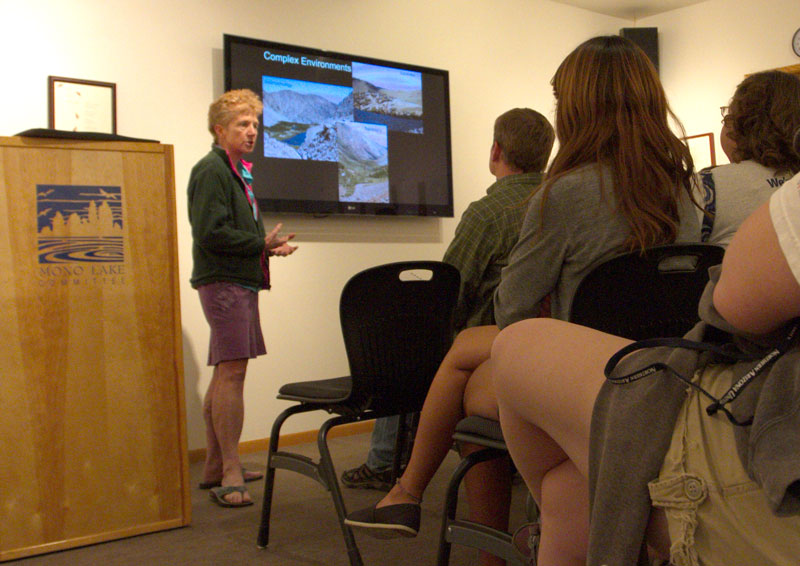
The aim of her talk was to illustrate the difficult task of predicting what kinds of ecological changes might result from fluctuations in global temperature and changing climate patterns, and how accepted wisdom about the effects on plants and animals needs to be carefully tested in the field.
Dr. Millar, faced with only 45 minutes to explain and defend her argument, chose several examples from her own research on mountain ecology to illustrate her point. One example was the case of changing growth patterns of trees in the Sierra Nevada as temperatures fluctuate. Our intuition is to think that as mountain ecosystems experience higher temperatures at higher altitudes, trees will adapt to these climate changes by growing at increasingly high altitudes along the Sierra Nevada range. However, as Dr. Millar illustrated in her presentation, this is not always an accurate picture of what takes place.
Instead, at least in the Sierra Nevada, what we seem to see is an increased density of trees growth at the upper boundary of the tree line. However, beyond this increased density of upper-bound tree growth, what we don’t seem to see is the upper boundary of tree growth increasing beyond its historical high-point. So while there appear to be more trees growing at the highest point in the Sierra Nevada, what constitutes the highest point doesn’t seem to be changing.
We also were shown a series of interesting data points regarding pika in the Eastern Sierra Nevada. The accepted wisdom about pika is that increasing temperatures in the region have altered their habitats, and thereby threaten the health and vitality of their populations. However, based on her own research, Dr. Millar has found that the preliminary results seem to indicate that while pika habitats are indeed changing, it doesn’t seem to be having an inverse effect on the health and size of the populations. They are merely finding new terrain to inhabit.
Dr. Millar used several such examples in an attempt to illustrate the way in which changes in mountain ecology defy our predictions, and thus why we should remain cautious about jumping to conclusions about how precisely climate change will affect mountain ecosystems.
Dr. Millar’s presentation was precisely the kind of talk that we enjoy having at the Mono Lake Committee. Using her own research in the Eastern Sierra, she was able to shed to light on an important topic for anyone interested in conservation in the region, and in doing so she was able to challenge accepted convention in a manner that was productive and thought-provoking—leaving all of us with a desire to learn more.
Please join us for our next talk, today 4:00pm. Ken Etzel, Eastern Sierra project leader for PRBO Conservation Science, while be sharing with us his research on birds in the Sierra Nevada.