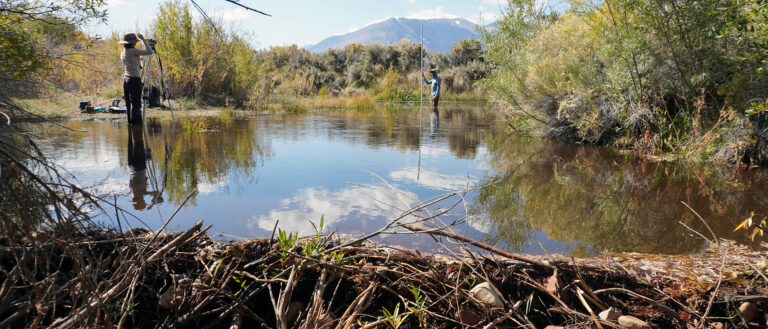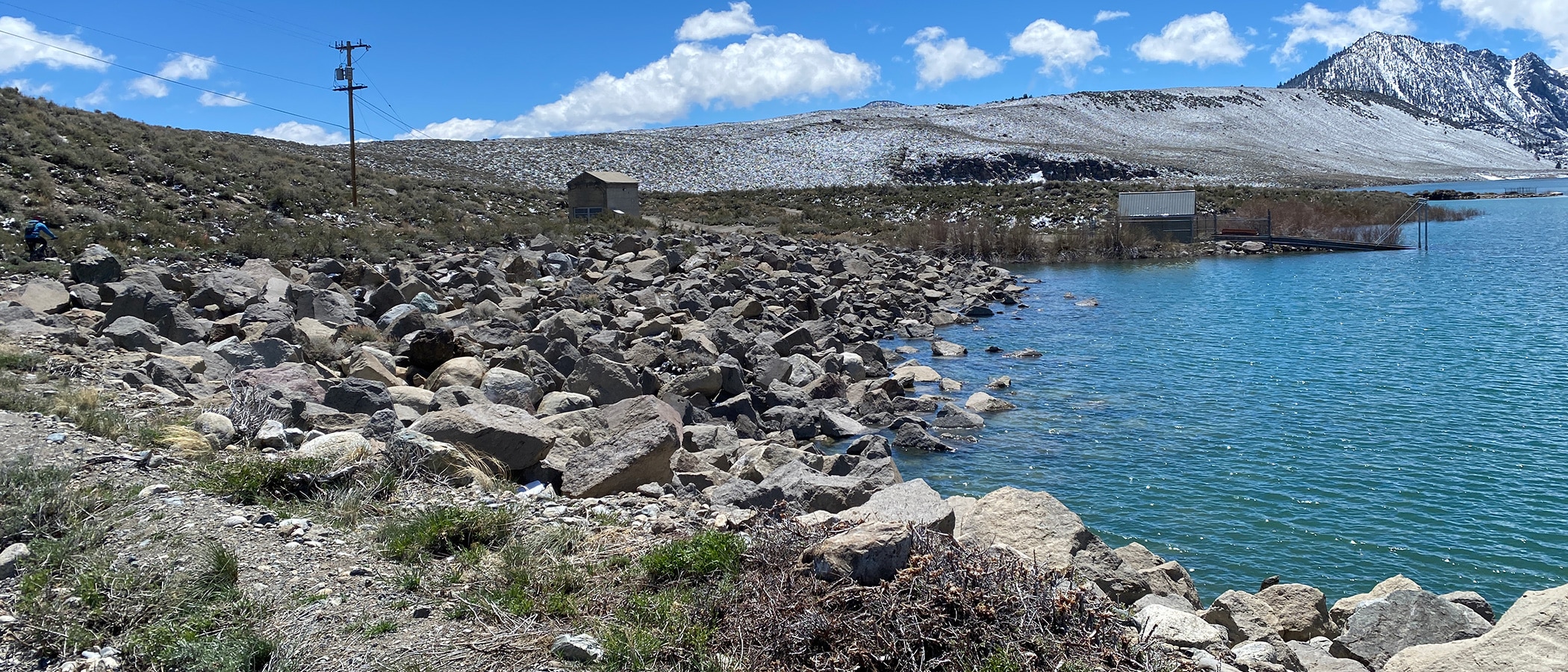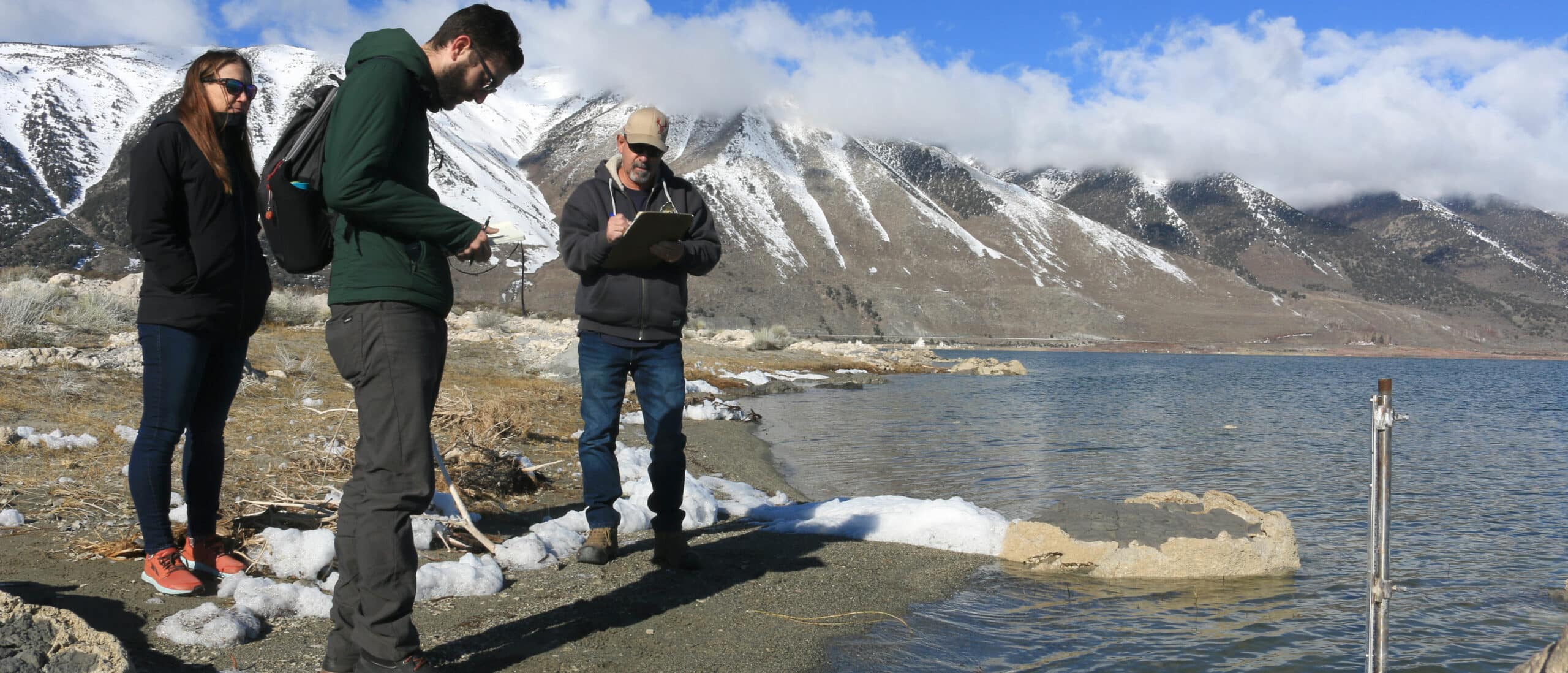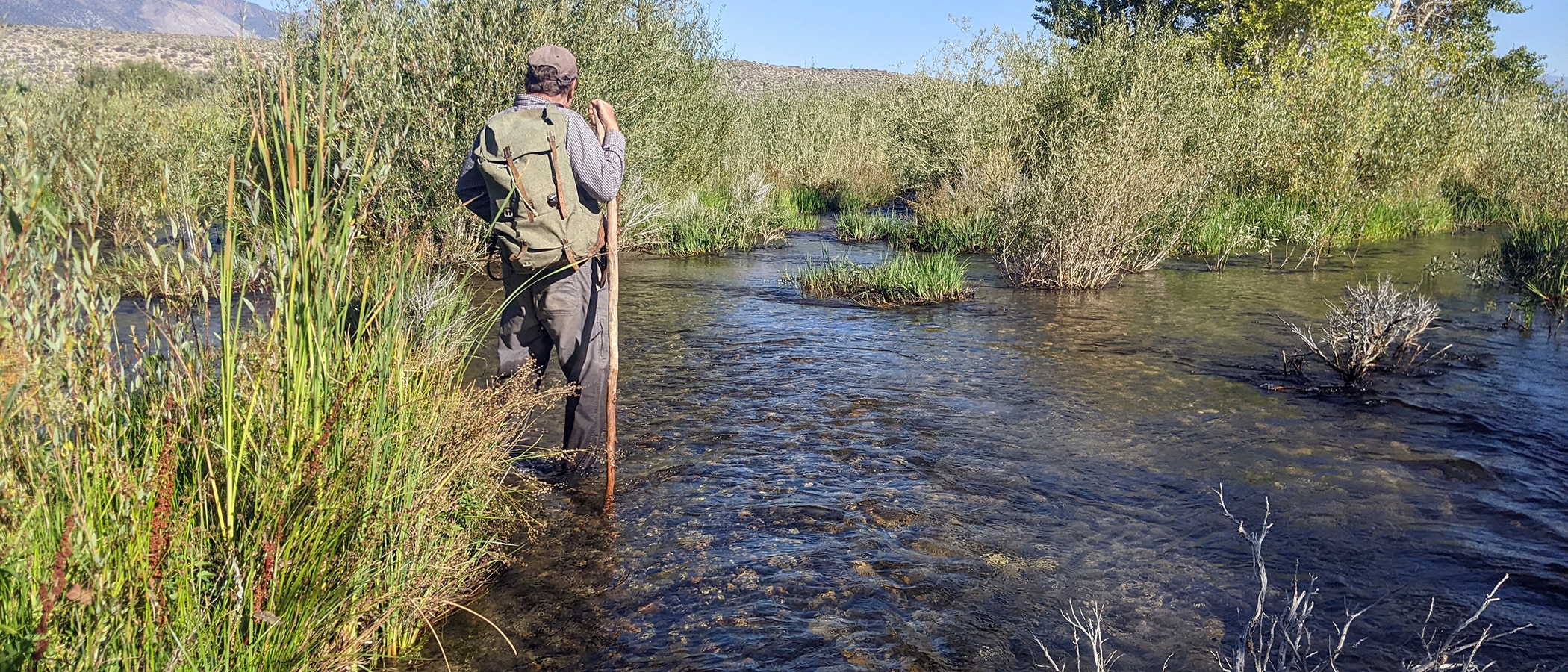
Mono Lake Intern Lynette Villagomez recording measurements at Mill Creek.
For many Mono Lake interns, one of the main draws of working for the Mono Lake Committee is the opportunity to work outdoors in the Mono Basin. One of the opportunities to do this is the weekly stream monitoring that the Committee carries out at Mill Creek. Mill Creek monitoring, as we call it around the office, is part of the broad effort to track the status of the streamflows and ecology of the five creeks that feed Mono Lake from the Sierra Nevada. (more…)
Sunday, August 12th, 2012 by Greg, Information & Restoration SpecialistcloseAuthor: Greg, Information & Restoration SpecialistName: Greg Reis Title: Information & Restoration Specialist About: Since his Committee internship in 1995, Greg has been involved with Mono Basin stream restoration and with maintaining the Committee's computers, Websites, and Research Library, and researching and compiling information for our programs. His B.S. degree from Cal Poly San Luis Obispo in Forestry and Natural Resources with a concentration in Environmental Management and a Senior Project in Hydrology reflects his interest in natural resources management, administration, planning, environmental analysis, and restoration. He is a member of the California Association of Environmental Professionals and the California Society for Ecological Restoration.See All Posts by Greg (134) Contact Greg
This summer is turning out to be drier than expected. Preliminary data for April–July show Lee Vining Creek runoff is about 1,000 acre-feet short of the 17,900 acre-feet (53% of average) forecast, Rush Creek runoff about 2,000 acre-feet short of the 23,400 acre-feet (49%) forecast, and Parker Creek runoff about 600 acre-feet short of the 3,400 acre-foot (62%) forecast. Only Walker Creek appears to be on target with its 1,300 acre-foot (42%) prediction—notably the lowest forecast of the four creeks. (more…)
Saturday, August 11th, 2012 by Greg, Information & Restoration SpecialistcloseAuthor: Greg, Information & Restoration SpecialistName: Greg Reis Title: Information & Restoration Specialist About: Since his Committee internship in 1995, Greg has been involved with Mono Basin stream restoration and with maintaining the Committee's computers, Websites, and Research Library, and researching and compiling information for our programs. His B.S. degree from Cal Poly San Luis Obispo in Forestry and Natural Resources with a concentration in Environmental Management and a Senior Project in Hydrology reflects his interest in natural resources management, administration, planning, environmental analysis, and restoration. He is a member of the California Association of Environmental Professionals and the California Society for Ecological Restoration.See All Posts by Greg (134) Contact Greg
Each May, the Los Angeles Department of Water & Power (DWP) submits its annual compliance report to the State Water Resources Control Board. This report contains not only compliance reporting, but the reports from the previous year’s lake and stream monitoring.
Some highlights from the 2011 monitoring include:
Brine shrimp abundance peaked at over 40,000 shrimp per square meter for seven of the last eight years. This level was only exceeded in five other years during the 1980s (monitoring began in 1982). But it has happened almost every year since 2004.
The “centroid” of the brine shrimp distribution over time has peaked earlier and earlier each year—as Mono Lake’s salinity has declined, the shrimp have (more…)
Thursday, August 2nd, 2012 by Erica, Project SpecialistcloseAuthor: Erica, Project SpecialistName: Erica Tucker Title: Project Specialist About: Erica learned about Mono Lake Committee while attending the Mono Basin Bird Chautauqua. She previously taught environmental education in Yosemite National Park and worked as a manager for a San Francisco Bay Area non-profit. During the winter of 2011-2012 she took a birding-focused, 13,000-mile cross country road trip, worked as a milker on a dairy goat farm, and built an 8’ x 16’ tiny house. Erica knows all the good birding spots around Mono Lake and is happy to share them!See All Posts by Erica (9) Contact Erica
Six of us are packed into a small motor boat, laden with kiddie gates, cardboard boxes, and a crate of old sheets. We are reviewing the strategy of our siege as we cross to Twain Island—move quickly, stay low, don’t stop. We are preparing to band California Gull chicks in several research plots on the small islands east of Negit Island in Mono Lake, a monitoring project that started in 1983.
California Gull chicks in a banding corral with the Krakatoa Island basecamp in the background.
By capturing the chicks in small plots that are surrounded by 2-foot-high chicken wire fences, we can examine the birds and extrapolate information on their health and reproductive success. In addition, hopefully the bands we fasten to the chicks’ legs will be seen in the future, allowing us to learn more about these gulls’ migration and nesting. (more…)
Monday, July 2nd, 2012 by Lynette, Project SpecialistcloseAuthor: Lynette, Project SpecialistName: Lynette Villagomez Title: Project Specialist About: A native of the Coachella Valley, Lynette attended Humboldt State University and graduated in June of 2012 with a major in Environmental Science and a minor in Natural Resources Planning. She enjoys traveling, knitting, baking, collecting agates, hiking, and exploring new places. She brings her interest in water politics and environmental justice to the Mono Lake Committee, where she manages social media and assists with membership. Lynette likes to paddle board on Mono Lake and has plans to someday build her own yurt.See All Posts by Lynette (8) Contact Lynette
One hundred and eighty two—that’s how many pounds of sweet clover we pulled on June 22nd with the help of volunteers from the outdoor clothing outfitter, Patagonia. The Patagonia crew came down from Reno to help the Mono Lake Committee kick-off the summer season of invasive plant removal along the Lake Trail at Old Marina.
The Patagonia crew on the Lake Trail, minus 182 pounds of the invasive plant, sweet clover. Photo by Arya Degenhardt.
Although it was hot out, and the soil was compacted, everyone was eager to tackle the daunting task of removing the hardy invasive plants. Sweet clover is (more…)
Monday, July 2nd, 2012 by Lynette, Project SpecialistcloseAuthor: Lynette, Project SpecialistName: Lynette Villagomez Title: Project Specialist About: A native of the Coachella Valley, Lynette attended Humboldt State University and graduated in June of 2012 with a major in Environmental Science and a minor in Natural Resources Planning. She enjoys traveling, knitting, baking, collecting agates, hiking, and exploring new places. She brings her interest in water politics and environmental justice to the Mono Lake Committee, where she manages social media and assists with membership. Lynette likes to paddle board on Mono Lake and has plans to someday build her own yurt.See All Posts by Lynette (8) Contact Lynette
Summer has arrived, and with it comes Restoration Wednesdays! Join the Mono Lake Committee to help restore the Mono Basin ecosystem. Restoration Wednesdays meet every Wednesday at the Mono Basin National Forest Scenic Area Visitor Center patio at 10:00am.
Lend a hand at Mono Lake on Restoration Wednesdays. Photo by Arya Degenhardt.
We will do a short introduction to restoration and the type of work to expect for the day followed by an excursion to the site. Restoration will either involve pulling of invasive plant species or watering Jeffrey pine saplings, (more…)
Wednesday, April 25th, 2012 by Geoff, Executive DirectorcloseAuthor: Geoff, Executive DirectorName: Geoffrey McQuilkin Title: Executive Director About: Geoff's goals for the Committee are: assuring Mono Lake's continuing protection, restoring Mono Lake's tributary streams, developing a permanent education program, and assuring that the strong tradition of scientific research at Mono Lake continues. A graduate of Harvard in the history of science, Geoff has worked for the Committee since 1992 and was an intern and volunteer before that. He's happy to live close to the lake with his wife Sarah and their daughters Caelen and Ellery.See All Posts by Geoffrey (105) Contact Geoffrey
In December 2011, a staff member at the Los Angeles Department of Water & Power (DWP) wrote to the State Water Board and recommended that the ongoing scientific monitoring of the ecological health of Mono Lake be discontinued.
Alkali flies floating on the surface of Mono Lake. Photo courtesy of Jonathan K. Armstrong, PhD.
Here at the Mono Lake Committee we were, in a word, shocked. Not only is the program a condition of DWP’s water export licenses, it is also a part of a signed legal settlement reached between the Committee, DWP, and other parties over a decade ago. Most importantly, monitoring of the lake is the essential scientific tool for measuring the ecological health of Mono Lake and its (more…)
Thursday, April 12th, 2012 by Greg, Information & Restoration SpecialistcloseAuthor: Greg, Information & Restoration SpecialistName: Greg Reis Title: Information & Restoration Specialist About: Since his Committee internship in 1995, Greg has been involved with Mono Basin stream restoration and with maintaining the Committee's computers, Websites, and Research Library, and researching and compiling information for our programs. His B.S. degree from Cal Poly San Luis Obispo in Forestry and Natural Resources with a concentration in Environmental Management and a Senior Project in Hydrology reflects his interest in natural resources management, administration, planning, environmental analysis, and restoration. He is a member of the California Association of Environmental Professionals and the California Society for Ecological Restoration.See All Posts by Greg (134) Contact Greg
As of April 1, the winter precipitation in Lee Vining added up to 45% of average, and Mono Basin snowpack measured 47% of average. The forecast for April–July runoff is 50% of average.
An average March for precipitation in the Mono Basin brought to an end the 2011 Runoff Year (April 1, 2011–March 31, 2012). The preliminary runoff total for last year is 142% of average. (more…)
Monday, January 23rd, 2012 by Arya, Communications DirectorcloseAuthor: Arya, Communications DirectorName: Arya Degenhardt Title: Communications Director About: Arya oversees the Committee's communications program, which includes the Mono Lake Newsletter. She loves her job because she gets to share the inspiring work of the Mono Lake Committee with members and visitors alike. When she's not in the office you might find her running with her dogs Dublin and Poco, volunteering with the Lee Vining Fire Department, listening to any music with a banjo in it, or willing the plants in her garden to grow. Her favorite things to do in the Mono Basin include ice skating on nearby lakes, skiing the Mono Craters, and getting to smell the sagebrush when it rains.See All Posts by Arya (91) Contact Arya
Mono Lake Committee Outdoor Experiences Manager Santiago Escruceria gives everyone a nickname. Beyer High School senior Tom Rydquist’s was “Mr. Muffin.”
In December 2011 the California Museum and Comcast announced that Rydquist won the Northern California Grand Prize in their Dreamers Challenge for a video he produced. His video “Funding the American Dream: Helping California Lead the Way in Water Reclamation” suggests a fee on sewage utilities to create water recycling programs. You can see Rydquist’s video here.
Beyer High School senior Tom Rydquist, left, monitoring water quality at Mono Lake with his classmates. Photo by Santiago Escruceria.
Along with fellow Beyer students from Modesto and their teacher Kay Myers, Mr. Muffin (more…)
Wednesday, December 28th, 2011 by Arya, Communications DirectorcloseAuthor: Arya, Communications DirectorName: Arya Degenhardt Title: Communications Director About: Arya oversees the Committee's communications program, which includes the Mono Lake Newsletter. She loves her job because she gets to share the inspiring work of the Mono Lake Committee with members and visitors alike. When she's not in the office you might find her running with her dogs Dublin and Poco, volunteering with the Lee Vining Fire Department, listening to any music with a banjo in it, or willing the plants in her garden to grow. Her favorite things to do in the Mono Basin include ice skating on nearby lakes, skiing the Mono Craters, and getting to smell the sagebrush when it rains.See All Posts by Arya (91) Contact Arya
Here in the office we call it the Collaborative Aqueduct Modernization & Management Plan, or CAMMP for short. But when we say things like, “Geoff, Lisa, and Morgan are CAMMP-ing,” it’s not what it sounds like. CAMMP is a State Water Board mandated series of facilitated meetings embarked upon by the Los Angeles Department of Water & Power, the California Department of Fish & Game, California Trout, the State Water Board-appointed Stream Scientists, and the Mono Lake Committee with the goal of working through the details of implementing the scientific streamflow prescriptions issued in 2010 and the associated aqueduct modernization necessary for the aging infrastructure to be able to reach the restoration goals at Mono Lake.
So … what does all that mean? It means that (more…)