There are a few moments in life that truly feel full-circle; working at the Mono Lake Committee has provided me with a few of them.
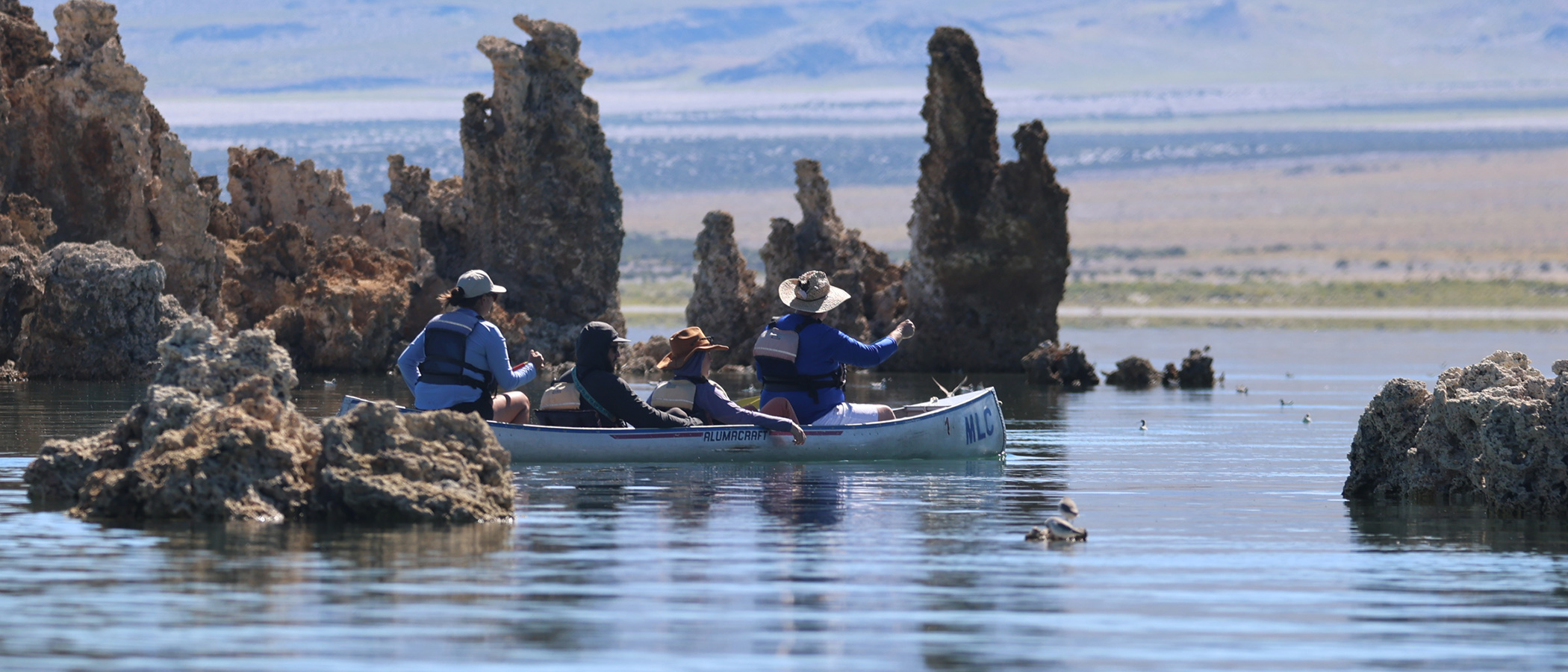
The most recent moment came earlier this spring, when I had the opportunity to take a group of Lee Vining Elementary School students on a guided canoe tour. The trip was particularly special to me because, at their age, I was sitting in one of those same canoes!
Years ago, I first experienced being on Mono’s waters as an LVES student on a Mono Lake Committee guided tour. I remember the feeling of adventure being out on the lake and the excitement of seeing and touching the mineral-rich waters. At the time, it was simply a field trip as a young student, a day to get outside with my classmates and learn about a part of our home. But it ended up contributing to a lifelong goal of loving and caring for the environment.
As I helped the students settle into their canoes and we pushed away from shore, I found myself thinking about how much can change in a few decades, and how much can remain the same. The lake was still there in all its glory: the familiar tufa formations, various birds skimming across the water, the Sierra Nevada towering above the basin floor. But my position had changed. I was no longer the young student looking for a guide for information; instead, I was the guide. Helping the students to notice the details of the lake and encouraging their questions about the ecosystem around them.
One of my favorite parts of working with students is that their curiosity often leads to unexpected directions. A question about a bird can become a conversation about food webs; a look at the tufa can lead to a discussion about the lake’s changing water levels; or a question about why I have a pickle jar sticker on my water bottle and if that means I like pickles as much as his mom does?
And, of course, the kids made the experience their own. There were lots of questions, laughter, observations, and excitement about getting a closer look at the brine shrimp. Watching the students experience the lake reminded me of why these opportunities are so valuable. Outdoor education is not only about learning facts about the ecosystem, its also about developing a relationship and respect with a place.
My own canoe trip was one of those experiences. I could not have known as a second grader that many years later I would become a Committee staff member and find myself helping create the kind of memory that had once been created for me.
The canoe trip only lasted an hour, but I hope that, years from now, some of these students will remember their first time on Mono Lake with reverence. The tufa, the birds, the curiosity, and the feeling of being out on the water together. And perhaps one day, they will find themselves coming back to share that experience with someone else.
For me, getting to guide this group was a reminder that education is also a form of stewardship. We share our knowledge of Mono Lake with the hope that the next generation will come to know the lake, care about it, and carry its story forward.
Top photo by Geoff McQuilkin.