Editor’s note: The following op-ed was written by University of Southern California Professor of Law, Erin Ryan, and ran in the San Francisco Chronicle on September 9.
Mono Lake still needs saving. Here’s what should happen next:
The California State Water Resources Control Board is rightfully turning attention back to how much water the LA Department of Water and Power should be taking from the Mono Lake Basin. With climate change putting more pressure on water resources, it’s high time to reconsider that question.
LA’s appropriation of water from remote places like Mono Lake is the original sin of the desert metropolis, with existential consequences for more rural parts of the state. But in recent commitments doubling down on municipal water reclamation, the city has made brave decisions shifting toward greater water security and stewardship.
The Water Board is also shifting in the right direction, holding new workshops on Mono Lake management. These provide an opportunity for both the city and state to do right by still-vulnerable Mono Lake and make good on the promise the state Supreme Court and Water Board made to its preservation over thirty years ago.
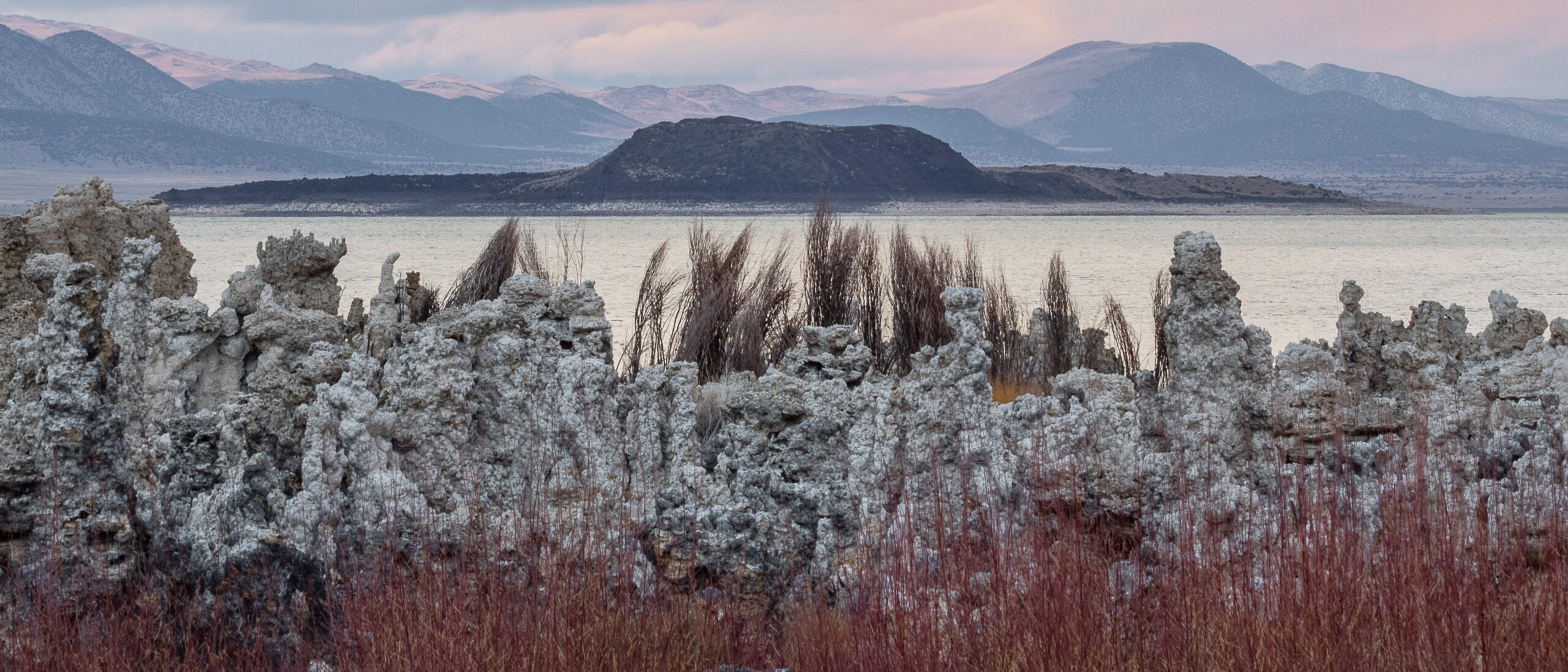
The eastern watershed of the Yosemite highlands, the Mono Basin is a staggeringly beautiful place—pierced by volcanic islands and geothermal activity, and adorned with limestone towers of tufa. Decades of diversions had drained the lake to the point of near ecologic collapse when a group of locals, birders, anglers, students and scientists campaigned to prevent its demise by reducing diversions to thirsty, mostly unaware Angelenos 350 miles away. Their groundbreaking public trust litigation to save it is the reason we can still enjoy Mono Lake’s wild splendor today.
Mono Lake is known worldwide for both its grandeur and its pivotal role in the development of the public trust doctrine—one of the oldest principles of the western legal tradition—as a tool of environmental law. It centers on the common-sense idea that some natural resources are so important to everyone that they cannot belong to just anyone, and so must be held in trust by the government for the benefit of all.
In 1983, in National Audubon Society v. Superior Court, the California Supreme Court took the first steps to protect Mono Lake by casting the public trust as a source of state obligation to protect the ecological, scientific and recreational values in the Mono Basin.
Today, Mono Lake is a case study on the challenges of, and possibilities for, balancing needs for public infrastructure with environmental values in an arid state—all within a system of law still evolving to manage these conflicts. One of the all-time great stories of environmental law, the case inspired like advocacy throughout the United States and in nations as distant as India. Public trust principles have migrated from the common law into statutory and even constitutional contexts, and the focus of trust advocacy has extended beyond its historic application to waterways to address groundwater, wildlife, ecosystems and even climate.
The Mono Lake case is most famous for its recognition that the public trust protects not only navigation and commerce but also ecological, scenic and recreational values. Another critical component was its recognition that trust responsibilities extend over time. After clarifying the state’s environmental obligations, the court explained that the doctrine imposes a continuing duty to supervise trust resources, long after initial management decisions are made. This ongoing duty of public trust oversight is what enabled and required the state to revisit water licenses granted to LA in the 1940s. Getting it wrong then did not alleviate the state from its obligation to get it right on judicial review in 1983, nor in the Water Board’s 1994 relicensing.
And it does not relieve the state from its ongoing responsibility to get it right today.
Nearly fifty years since the original litigation, Mono Lake is not yet saved. Currently at 2.5 million acre-feet, it has made barely half the progress the Water Board expected as diversions to LA continue. DWP has been taking the maximum 16,000 acre-feet allowed by the Water Board every year, for a total of 3.5 million acre-feet since water exports began. New data generated by UCLA scientists reveal that Mono Lake will struggle to reach the recovery lake level the Water Board set in 1994 if exports continue without consideration of new factors like climate change. The duty of ongoing public trust oversight means it is time to reconsider diversions levels with the benefit of new research, new water planning in LA and decades of on-the-ground experience.
The Water Board deserves enormous credit for Decision 1631, its carefully calibrated 1994 plan to protect Mono Lake at a healthy level. Los Angeles also deserves credit for achieving remarkable feats of water conservation since then. And now, both the Water Board and LA deserve credit once again: the Board showed great foresight in commissioning the UCLA study to better understand Mono Lake’s stalled recovery, and the City has committed to substantially increase its water recycling capacity, reducing dependence on Mono Lake and other out-of-basin water sources.
The mounting evidence of ongoing threats to Mono Lake’s recovery provide new opportunities for courage and creativity. Richard Katz, President of the Board of Water and Power Commissioners, called LA’s embrace of water reclamation “a solution with lots of winners,” observing that once recycled water starts flowing, “we won’t need Mono Lake water to meet the supplies in LA.” He’s right, and it’s time for the Water Board to recommit to safeguarding the public’s irreplaceable environmental interests in the Mono Basin. The science is clear, and so is the law—the state holds an ongoing public trust obligation to protect Mono Lake, which, after all, belongs to all of us.
Erin Ryan is the Charles & Ramona Hilliard Professor of Law at the University of Southern California, Gould School of Law, and the author of Law for the Land: The Public Trust Doctrine, Mono Lake, and a Quiet Revolution in Environmental Rights (Cambridge University Press, 2026). In the mid-1990s, prior to law school, she served as a US Forest Service ranger at Mono Lake in the immediate aftermath of the California Supreme Court’s Mono Lake decision and the State Water Board’s relicensing Decision 1631.
Top photo courtesy of Joaquin Baldwin.