Mono Lake’s brine shrimp and alkali fly populations are showing measurable and significant signs of strain due to Mono Lake’s water level being too low for too long. That was the big takeaway from the State Water Board’s Mono Lake Public Workshop 1.
During the two-hour workshop on June 4, the spotlight was on the tiny, fascinating, food-producing engines of Mono Lake’s unique food web, and the salinity of the water they live in. Two longtime Mono Lake expert scientists presented—Dr. John Melack on limnology and brine shrimp, and Dr. David Herbst on alkali flies. At the request of the Board, the focus was on data and trends observed since the Board’s 1994 Decision 1631 that set the current protections for Mono Lake.
While the research presented was complex, the takeaways are straightforward and familiar. The scientists shed new light on the increasingly urgent need to raise Mono Lake to the Board’s mandated level with documented, measurable, and accumulating impacts on the ecosystem of the chronically low lake level.
Long term trends for brine shrimp at low lake levels include a small decline in overall abundance, declining reproduction, declining egg (cyst) production, and decline in body size. Low lake levels enable multi-year lake stratification, which impairs the ecosystem. For alkali flies, the high salinity of a low lake inhibits growth rates, extends development time, reduces the size at maturity of pupae and adults, and reduces food and habitat availability. Collectively, these impairments mean a less productive ecosystem that is less able to provide food for the millions of migratory and nesting birds that make Mono Lake famous.
The workshop was the first in a series the State Water Board is holding in order to gather information on the condition of Mono Lake’s public trust resources and potential management options in preparation for a hearing to determine whether Mono Basin water diversions should be modified to reach Mono Lake’s legally mandated water management level.
The state of Mono Lake’s water and brine shrimp
Dr. Melack is the Board-appointed Mono Lake Limnology Monitoring Program Director, and a limnologist and aquatic ecologist whose work examines the lake’s physical, chemical, and biological dynamics. He has conducted research at Mono Lake since 1979 and gave testimony before the Board for its 1994 decision.
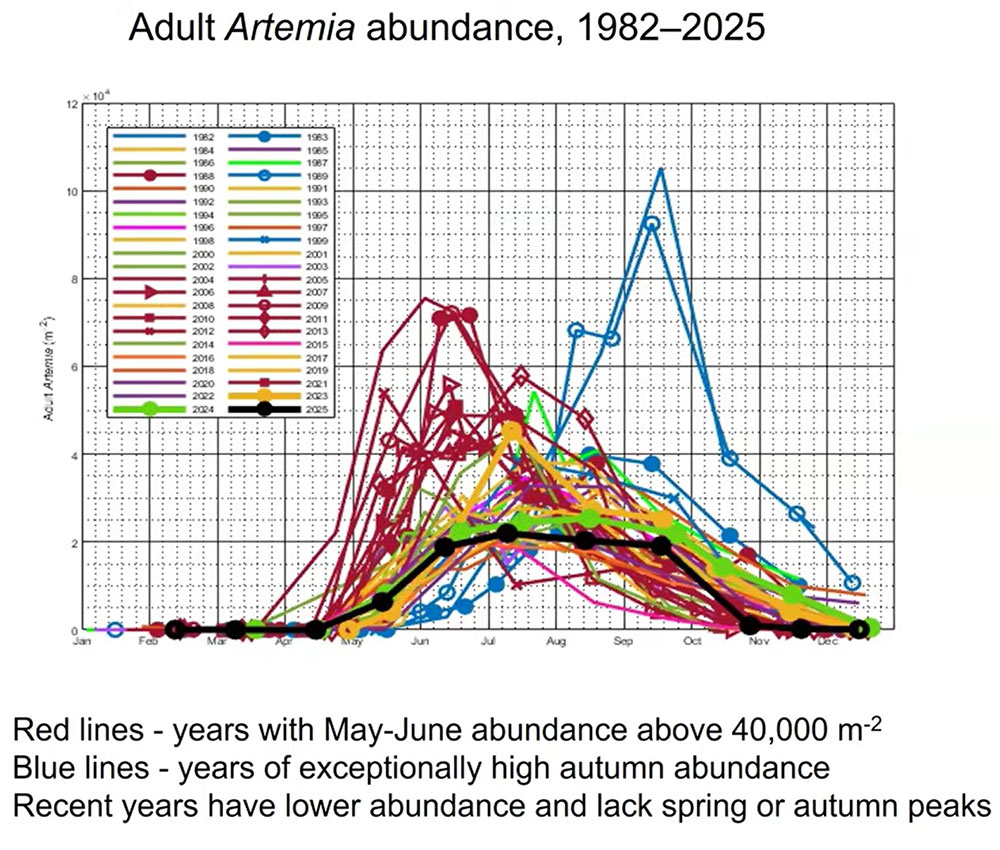
Melack reported significant findings—a 40% decrease in annual production of over-wintering brine shrimp (Artemia monica) cysts, a 42% decline in brine shrimp abundance-weighted fecundity (reproductive capacity), and an 11% decrease in adult female length.
“We’ve seen a significant decline in [brine shrimp] fecundity and less variability. And this trend is significant, and, to be honest with you, we don’t fully understand it, but it’s clearly and issue that needs more attention.”
—Dr. Melack, Workshop 1
On the surface, it is unsurprising—a lower lake means higher salinity, which means fewer shrimp eggs, less reproduction, and smaller shrimp. However, what was presented was the cumulative effects and impacts from the chronically low lake level.
Additionally, the salinity story is not quite as simple as lower lake equals higher salinity. Melack walked the Board through the limnology needed to understand the cascading and compounding negative ecosystem effects on Mono’s gulls, phalaropes, and grebes.
Lake level, meromixis, and fewer, smaller brine shrimp
Since limnology and brine shrimp studies began, there have generally been two peaks in shrimp abundance each year—one peak in spring, and another in summer. The spring peak occurs when over-wintering cysts hatch, which also coincides with the start of California Gull nesting season. The number of shrimp in this peak is related to the number of cysts that hatch after overwintering at the bottom of the lake.
When Mono Lake is low and then gets a big influx of spring runoff, the lake can become chemically stratified, or meromictic. Melack described meromixis as “the lake is partitioned into a deeper region, which has one set of conditions and an upper region, which has a different set of conditions.”
When the lake is meromictic, the vertical distribution of nutrients, phytoplankton, and oxygen in the water is affected. Specifically, brine shrimp cysts, which typically rest on the lake bottom, are trapped in the unmixed, lower, anoxic, water layer in conditions where they cannot hatch.
Melack explained “… when you have a stratified lake like Mono Lake, which persists for years, the whole bottom of the lake, in this case below 15 to 20 meters, it has no oxygen and it has a lot of other chemical compounds that are associated with low oxygen. It’s a quite inhospitable environment for organisms like Artemia. So, basically their lake, if you will, is limited to the oxygenated part of the lake and their cysts aren’t going to hatch in regions that are anoxic. So, if you have long periods of anoxia and chemical stratification, it reduces the region of the lake from which cysts can actually hatch.”
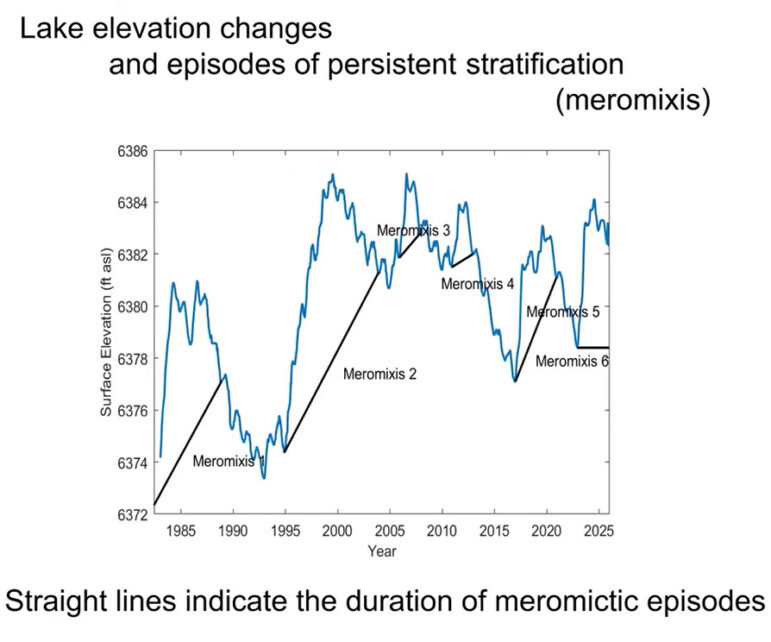
Mono Lake has experienced five meromictic periods since 1994, and is currently in the sixth, which began following the big spring runoff of 2023.
“At higher lake levels it takes more water to cause a density gradient that might lead to persistent stratification.”
—Dr. Melack, Workshop 1
Melack explained, “We calculated for three different lake levels: 6,372–6,374, which was the historic low in the late 70s, a mid-range, which is kind of the range we’re in right now, 6,382–6,384, and then the mandated level 6,392– 6,394. And what you see is that to cause an episode of meromixis takes progressively more water and the resulting density gradient is less because there’s more volume with a lake associated with a higher lake level. So, the conclusion of this simple analysis would be one might expect less episodes of meromixis at higher lake levels.”
The data says: the best way to protect Mono Lake from stratifying is to raise the lake to 6,392, the sooner the better.
When the lake is higher it is less likely to become meromictic, so raising Mono Lake to the State Water Board’s 6,392’ mandate is clearly the first step—and not only for the shrimp.
“At current lake level ranges we expect episodes of persistent stratification to occur and persist. We would expect, and have observed, lower algal abundance, decreased Artemia fecundity, lack of oxygen in deep water, reduced Artemia cyst hatching, and altered changes in the distribution through time of the Artemia which has consequences for the birds,” Melack said.
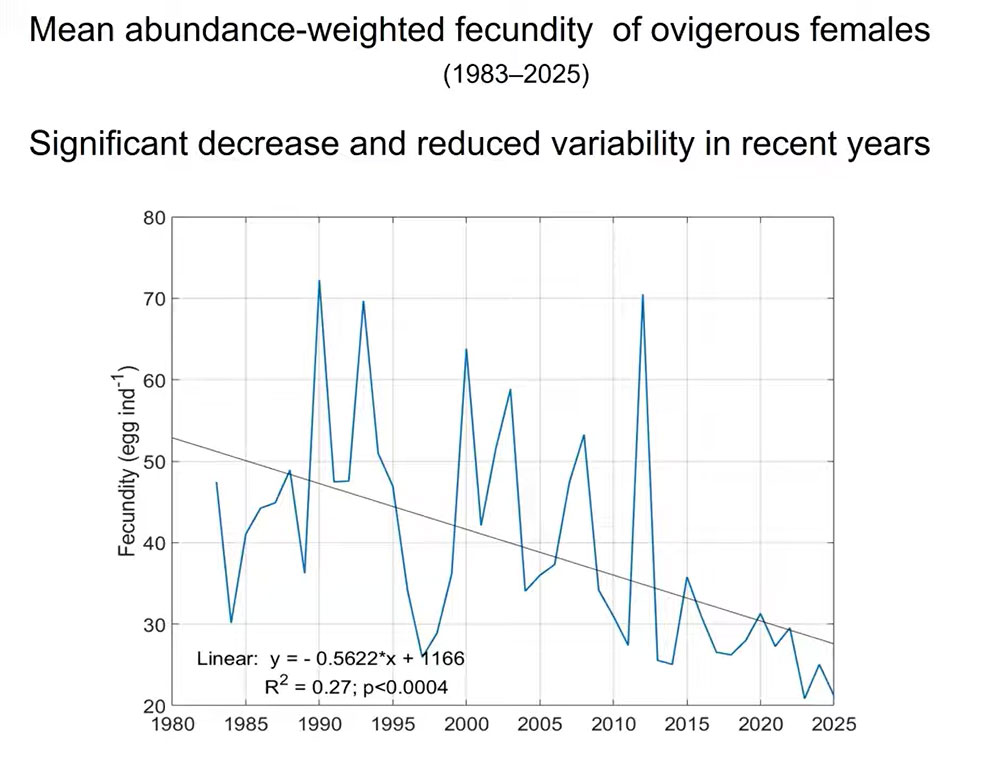
Melack went on to explain that, “The other aspect of female fecundity is the size of the females. It’s not too surprising, larger females are likely to produce more offspring than smaller ones. And again, this is a not a big change, but the female shrimp are getting progressively smaller through time.”
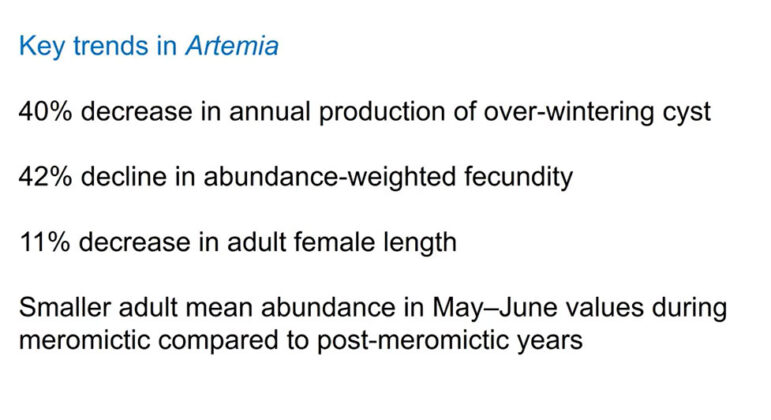
“Overall, we’ve seen about a 40% decrease in the annual production of overwintering cysts. We’ve seen a decline in female fecundity in the same order, and an associated decline in female length. We’ve generally seen smaller mean adult abundances in the spring during meromictic periods compared to non-meromictic periods,” he said.
What this means for birds will surely be a question at the June 25 workshop on “California Gulls and Other Migratory Birds,” but it seems safe to assume that if brine shrimp are both less abundant and smaller, it would have an adverse effect on the nesting and migratory birds that depend on them for survival.
At the end of his presentation Melack also addressed a new limnological curiosity observed in the last decade or so.
“I also want to point out a condition which, again, surprised us. In the 2014–2016, and 2020–2022 periods many local people noted the lake stayed green all summer, which meant that the Artemia weren’t grazing the algae down or the algae were growing faster than they had in the past. And so, we’ve done some modeling to try to explain this, and it seems to be very much a function of a pretty delicate balance between the grazing by the Artemia and the growth of the algae. But it has consequences because under these really green conditions, and this will come up with the bird people’s talks later this month, it’s hard for the grebes to feed when the lake is so turbid. So, the combination of lower Artemia and turbid water is a connection between algal abundance, Artemia abundance, and grebe behavior and feeding.”
Seeing Mono Lake stay green all summer instead of gradually getting clearer through the season has prompted much speculation, and it will be good to hear about it from the experts at the next workshop.
The state of the alkali flies
Dr. David Herbst is a saline lake and stream ecosystem aquatic ecologist. He studies the alkali fly (Ephydra hians)—examining salt adaptation, salinity effects on alkali fly growth and productivity, algae dynamics, tufa formation, and habitat relationships of fly larvae and pupae. He has conducted research at Mono Lake since 1976, and he also gave testimony before the Board for its 1994 decision.
“The data argues that we would expect conditions in Mono Lake to become more productive by raising the lake level to 6,392 and the attendant improvements for growth, development, reproduction, population productivity and habitat availability for the alkali fly.”
—Dr. Herbst, Workshop 1
Dr. Herbst addressed the Board’s question of whether there is a reason to accelerate increases in lake level, and if the lake level of 6,392′ would improve the ecological status of the lake. His presentation walked through his research on alkali flies and how they are affected by different salinities. “Salinity is a controlling factor in the growth, development, and productivity of the alkali fly. Increasing salinity inhibits growth rates, extends development time, reduces the size at maturity of pupae and adults, and ultimately reproductive success.”
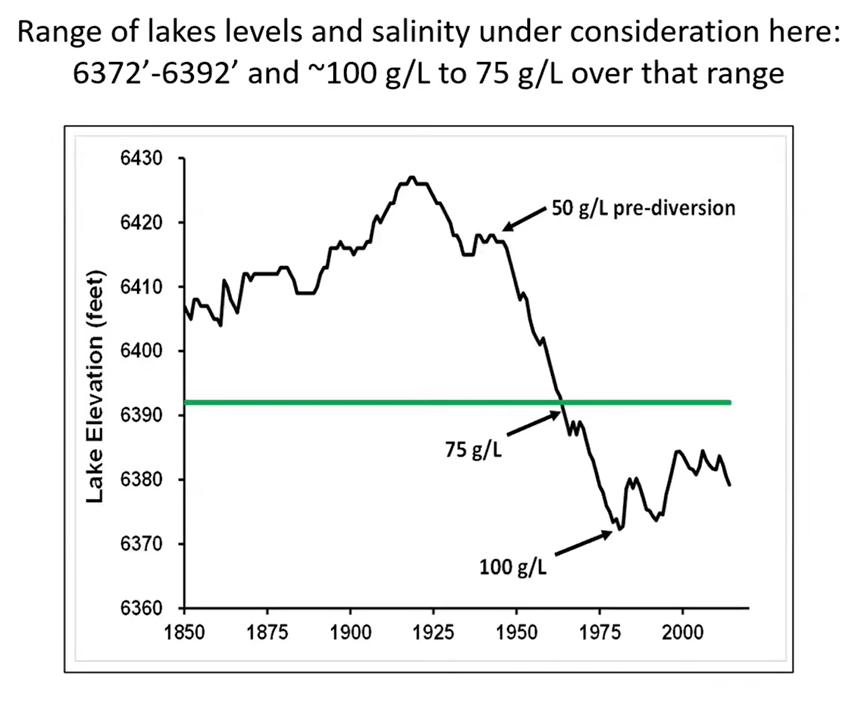
Water salinity is important to the biology of both alkali flies and brine shrimp. “Physiological osmoregulators,” as Herbst described them, must maintain a constant concentration of salt in their blood to survive. This means that when the water around them increases in salinity, they have to use more energy to pump the extra salt out of their bodies. “Salinity limits [alkali fly] growth and reproduction due to the cost of osmoregulation, and salinity kind of acts as a vice on their capacity to be able to be productive because not only is the demand for that energy increasing, but the supply of food that could meet those demands is being reduced.”
Herbst’s research involves experiments on the growth and development of alkali flies that show clearly how increases in lake salinity negatively affect alkali fly development and reproduction.
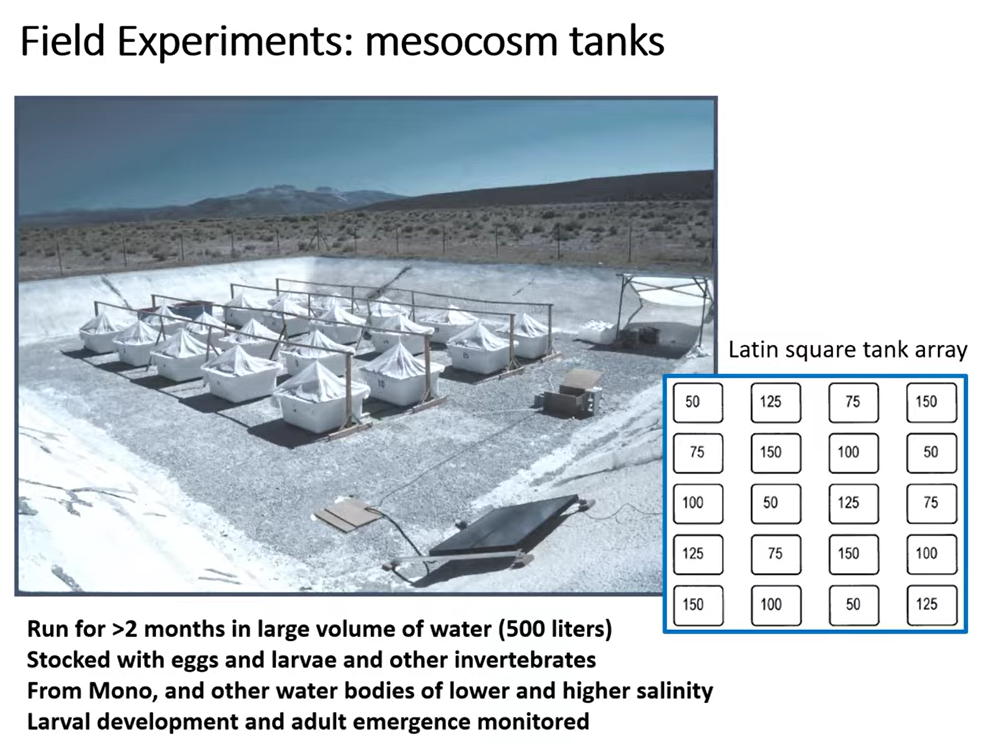
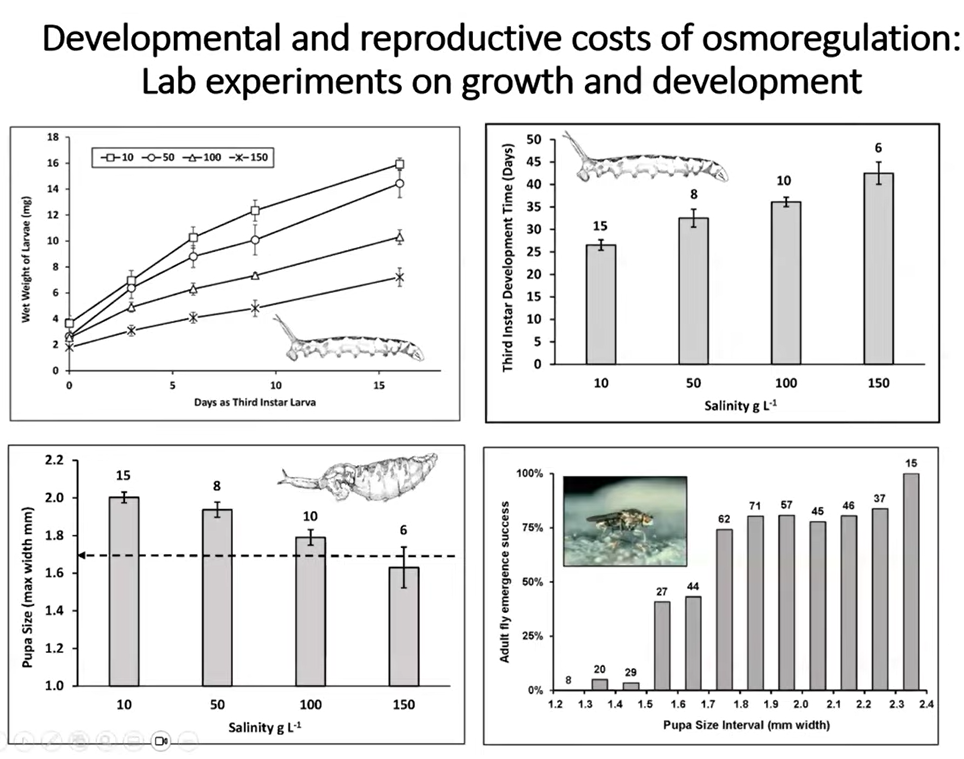
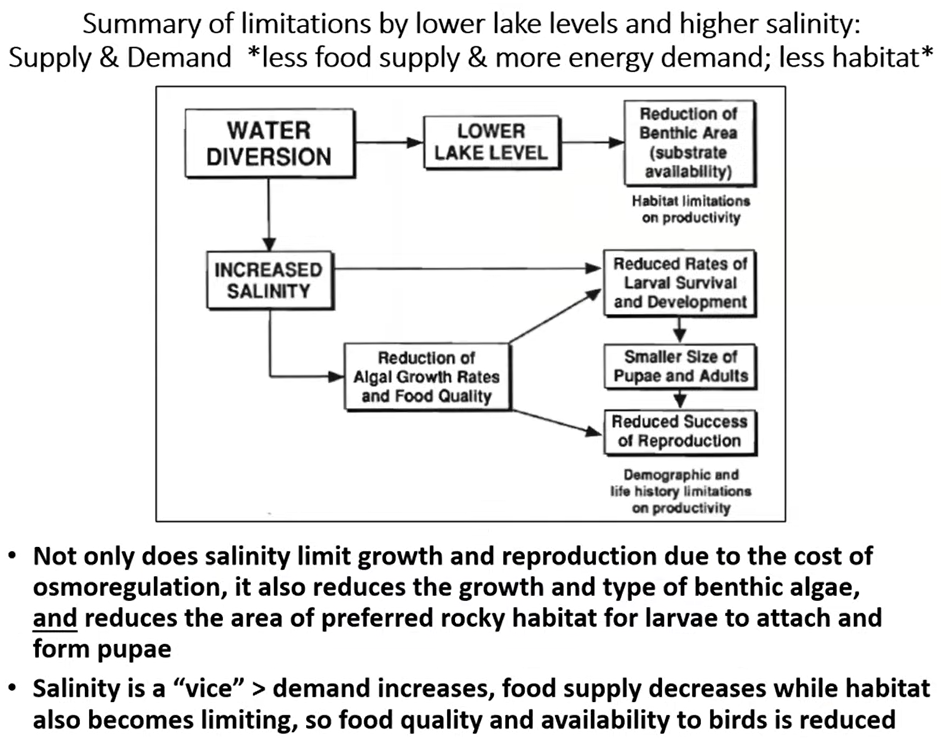
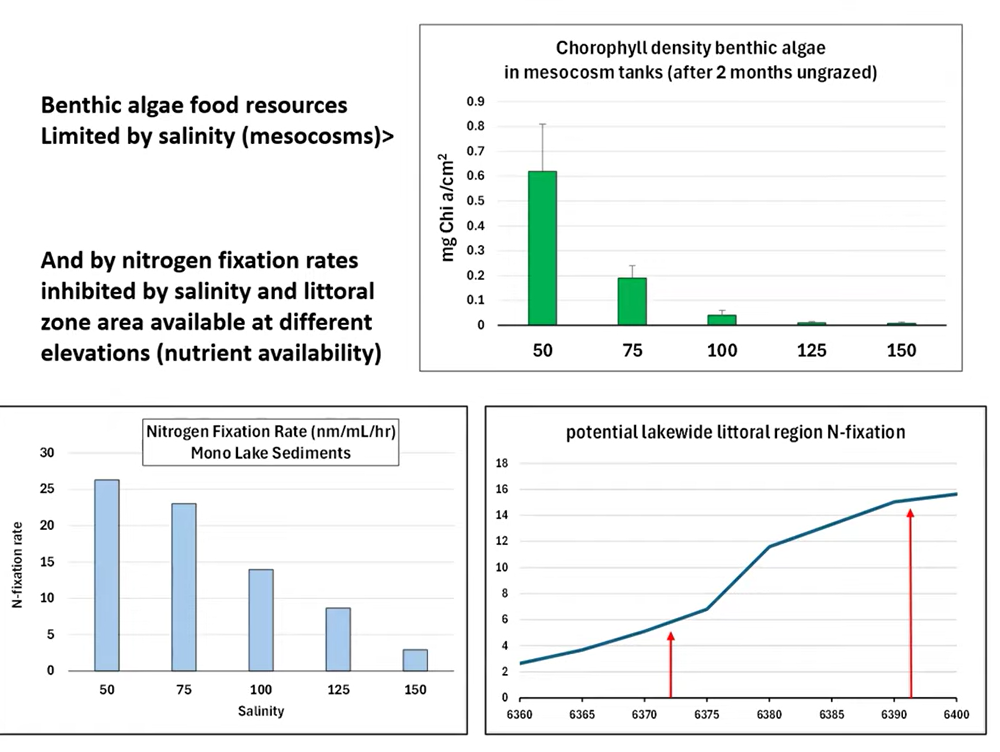
Herbst explained that, “With water diversions, you get a lower lake level and increased salinity. The lower lake level results in a reduction in the benthic area and substrate availability. The increased salinity results in a reduction of the algae growth rate, so there’s not as much food supply. That, along with the constraints of increasing salinity results in reduced rates of larval survival and development, smaller size of pupae in adults, and reduced reproductive success as a consequence of that.”
“Collectively, these factors support the expectation that higher lake levels would significantly improve alkali fly productivity and enhance food availability and quality for waterbirds that forage at Mono Lake,” he said.
The science shows urgency
During the workshop both scientists brought complex science into focus for the State Water Board. The solution to myriad issues remains clear and familiar. The State Water Board’s original lake level compromise (6,392′) remains essential to the Board’s duty to protect the Public Trust. If anything, the science shows the need to raise the lake has only become more urgent in the last 32 years.
A full recording of the Workshop is available here.
- Intro, agenda, and meeting purpose (2:50)
- Dr. John Melack (8:00)
- brine shrimp population cycles (14:30)
- meromixis (20:10)
- anoxic water, shrimp hatch, and ammonium concentration (27:30)
- lake transparency and meromictic episodes (29:00)
- brine shrimp abundance (30:45)
- brine shrimp abundance-weighted fecundity (33:15)
- trend toward shorter females (34:20)
- summary of trends (34:50)
- Dr. David “Dave” Herbst (48:10)
- research methods and data (50:05)
- alkali fly life cycle (52:15)
- tufa formation (1:01:35)
- littoral zone densities of fly larvae and pupae on tufa (1:03:50)
- osmoregulation and the cost to growth and development (1:10:15)
- lab experiments on the cost of osmoregulation on fly growth and development (1:14:45)
- field experiments to analyze the effects of salinity (1:18:10)
- salinity effects on algae (1:41:25)
- summary of limitations by lower lake levels and higher salinity (1:52:15)
- conclusion (1:27:30)
A full recording of Workshop 2 is available here: Workshop 2
Top photo by Robbie Di Paolo.