
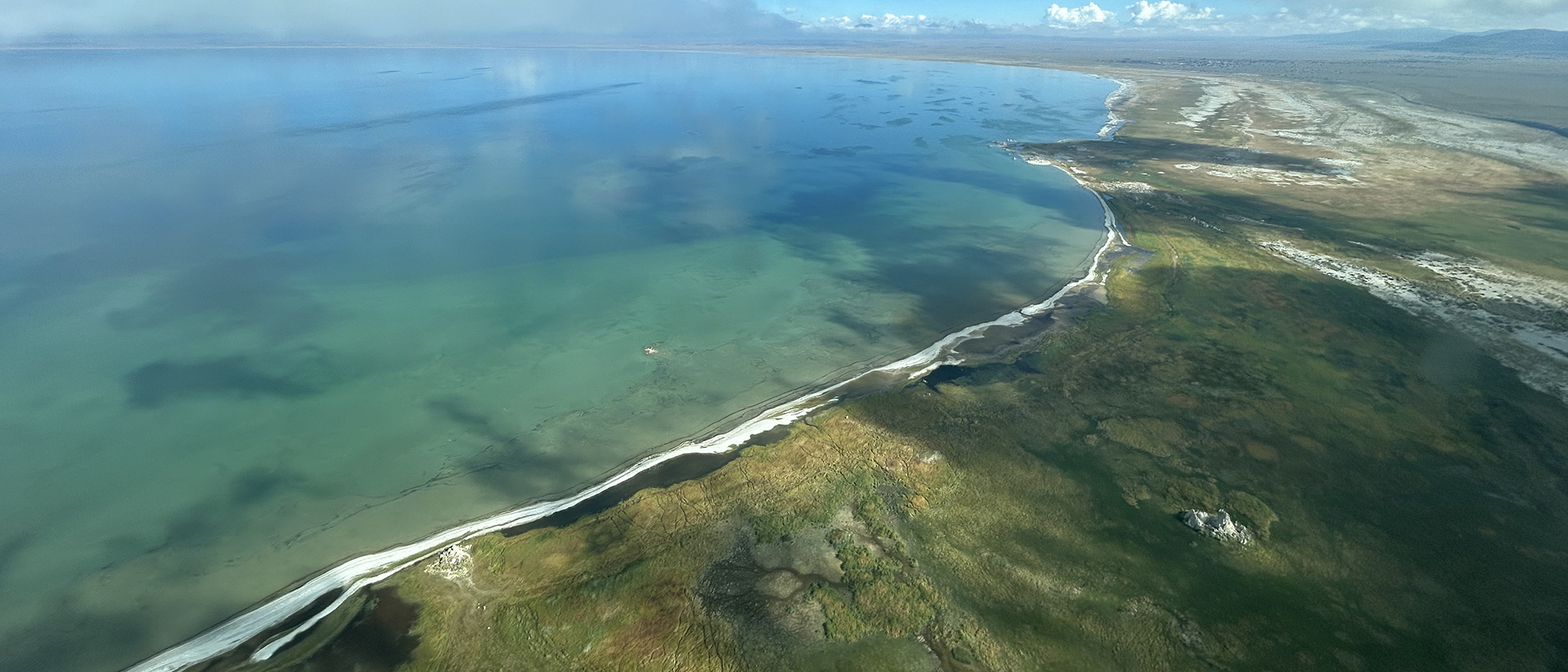
It’s not every day that your dreams and scientific research converge, but sometimes the stars—or the grebes—align, and something magical happens.
That’s exactly what happened on September 20, 2025, when I had the unique opportunity to join one of the four Eared Grebe survey flights of the year, led by our Restoration Field Technician, Robbie Di Paolo. These flights, typically conducted between mid-August and mid-November, are timed to maximize the likelihood of documenting peak abundance of Eared Grebes (Podiceps nigricolis) on Mono Lake.
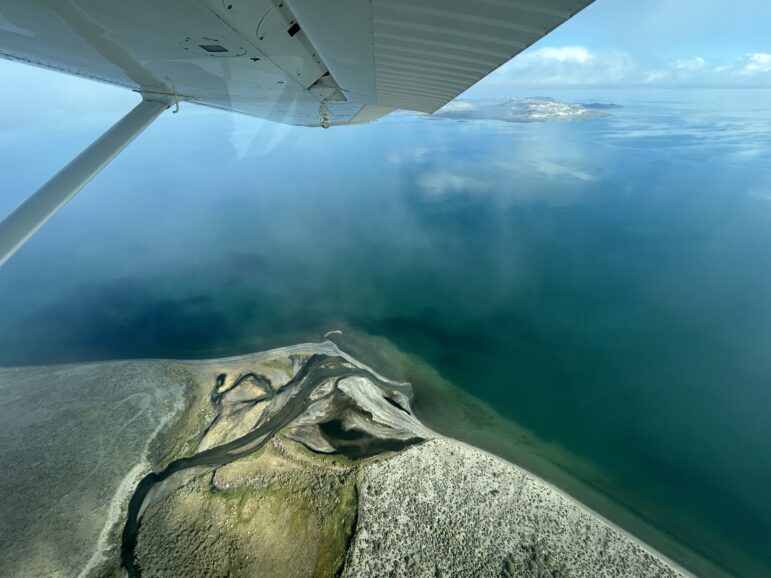
Each fall since 2008, the Mono Lake Committee has partnered with biologist Dr. Sean Boyd of Environment and Climate Change Canada to conduct aerial surveys of Eared Grebes during their migration staging period. The purpose is simple yet vital: count the birds over time and space to better understand their arrival timing and abundance. Data that ultimately illuminates the ecological health of this hypersaline lake.
Mono Lake is an unusual and critical stopover for Eared Grebes. Nearly the entire North American population of Eared Grebes stages at Mono Lake and Great Salt Lake each fall. At Mono Lake, more than half a million Eared Grebes feed heavily on brine shrimp and alkali flies as they molt, double their body weight, and launch for their wintering grounds in Southern California and Mexico.
The aerial surveys are made possible by our long-time partnership with LightHawk, a nonprofit aviation organization that supports conservation work with donated flights and volunteer pilots.
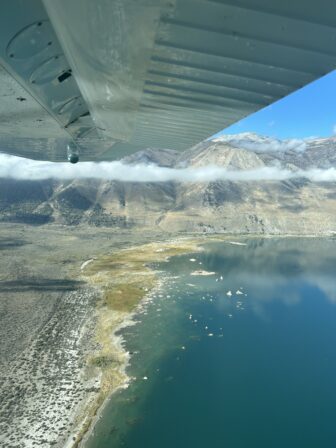
Flying in a four-seater plane was intimidating at first. I had never flown in such a small plane before, and the coffee I had for the early morning expedition didn’t help my nerves. The early autumn clouds seemed low and whispering, and I watched the sea of sagebrush shrink beneath us as we lifted off. As we climbed above the mist into the abundant Mono Basin sky, everything shifted. The lake widened into a brilliant mirror, and the familiar craters and ridgelines of the basin revealed themselves. I felt, with startling clarity, what it must be like to be a bird, to see the landscape from an otherwise impossible vantage point.
Below, Mono Lake gleamed with colors I’d only imagined in tropical regions: deep cerulean fading into aquamarine, bordered by the mustard yellows and emerald greens of the grasses and spring-fed banks. Remote shallow pools rich with minerals cast bright reds and oranges against the muted, autumn-colored shorelines. It was like learning a secret language of the basin, one that only high altitude could teach.
And then, there they were!
Thousands of miniature specks shimmered on the water’s surface; the grebes were spread in clusters across the lake, tiny, yet unmistakable. Occasionally the plane’s engine would rumble, and the birds skittered across the water in tight lines, leaving patterns on the lake like strokes on a painting. Their fevered movement spoke to their urgency and instinct; the need to feed, fatten up, and eventually, depart.
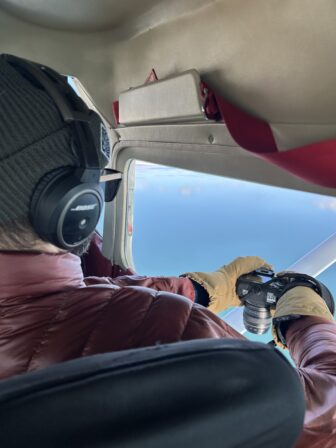
From above, the scale of life at Mono Lake becomes both a joy and a data set. During these aerial surveys, Robbie photographs the lake at equal intervals across established aerial transects so that each grebe can later be counted from the images, a meticulous process that transforms dots into numbers that reveal patterns in timing, abundance, and habitat use.
As the flight comes to an end, what hits me most as I look down at the basin is not just this scientific research, though that is powerful, but the beauty and mutuality of it all. Here lies a lake so salty and mineral rich, yet winged travelers are drawn here year after year for its life sustaining features. It feels like a privilege to contribute, in even a small way, to the ongoing story of these birds and this special environment.
Mono Lake is a refuge, a laboratory, and for me on that day, a mirror of what it means to care for the natural world: to witness, to record, and to feel.
Special thanks to Dr. Sean Boyd for providing expert guidance and oversight for this long-term research project, LightHawk volunteer pilot Wayne Sayer, and thank you to expert volunteer Eared Grebe counter, Igor Vorobyoff.
Top photo by Olivia Nelson.