
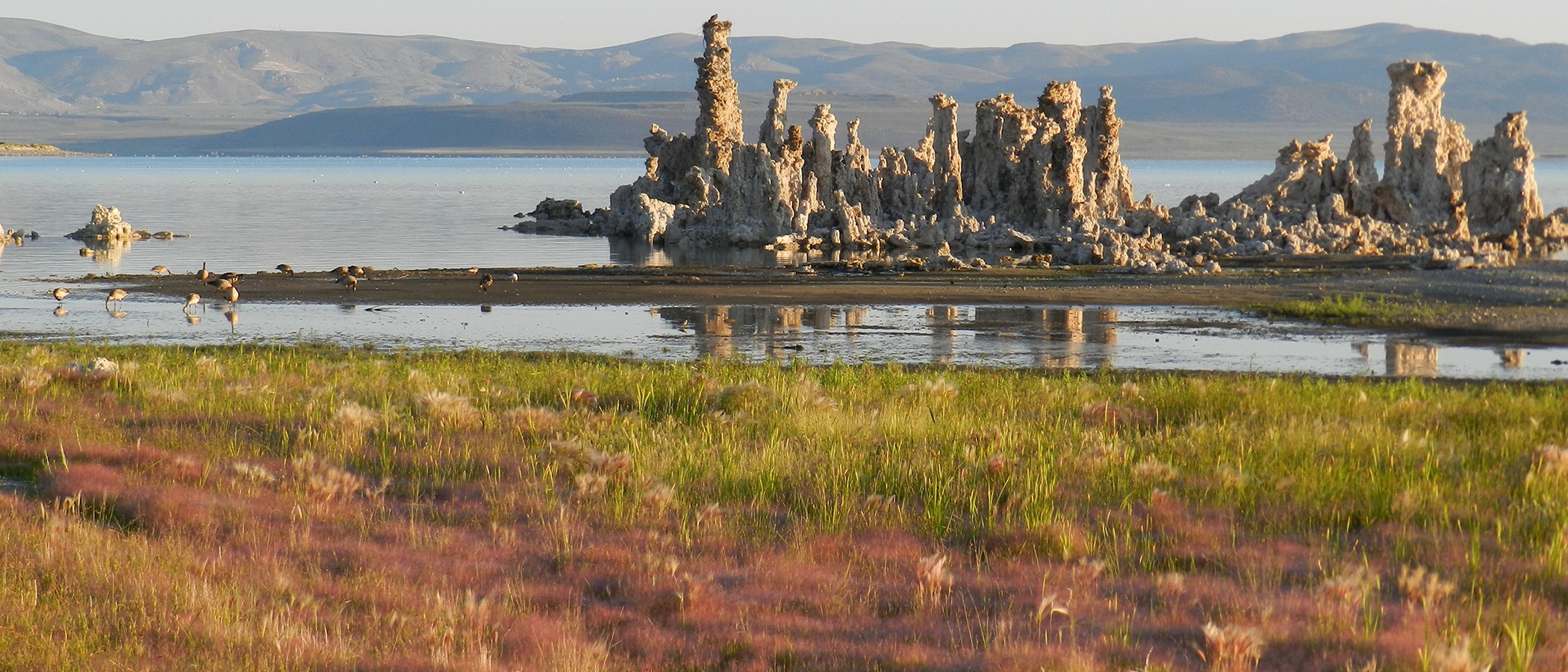
Wildrose Canyon is an isolated riparian corridor and aspen grove in the Glass Mountain Range that hosts a variety of awesome species along its mile-long stretch—Calliope Hummingbird, Plumbeous Vireo, Cooper’s Hawk, MacGillivray’s Warbler, Dusky Flycatcher, and Lazuli Buntings are some species you may see. There is a chance to see (or hear) the elusive Virginia’s Warbler. We’ll focus on intermediate-advanced aural and visual birding skills, behavioral observation skills, and natural history of the species we encounter. Be prepared for potentially rugged and uneven terrain, as the unmaintained dirt road often washes out with spring runoff. Join Nora on a walk up this gem of a canyon—it’s worth the drive! Bring water and sun protection, as well as snacks or lunch.
Date: Friday, June 19
Time: 6:00am-12:00pm
Instructor: Nora Livingston
Meeting location: CCF A
Difficulty rating: moderate
Driving distance: 100 miles
Crowley Lake Reservoir, cradled in the Long Valley Caldera and formed by the damming of the Owens River, offers spectacular views of the High Sierra to the west and the Glass Mountain and White Mountain ranges to the east. Crowley is nestled amid a mix of sagebrush, wet meadows, and small alkali lakes, attracting a variety of breeding and migrant waterbirds. June is the peak of the breeding season, so we should see several species of nesting ducks, shorebirds, and grebes, plus some over-summering non-breeders and late migrants. We will also view a variety of swallow species, enjoy the beautiful song of the Sage Thrasher, the subtle beauty of the Brewer’s Sparrow, and if we are really lucky, run into some Bi-State Greater Sage-Grouse. Bring snacks, water, sunscreen, and layers.
Date: Friday, June 19
Time: 6:00am-12:00pm
Instructor: AnnaLisa Mayer
Meeting location: CCF B
Difficulty rating: moderate
Driving distance: 80 mi
Mile-long Convict Lake, located at 7,600 feet above sea level about 40 miles south of Lee Vining, lies in a glacial basin under Laurel Mountain and Mount Morrison, two towering metamorphic peaks. The trail encircling the lake goes through a range of habitats where you can expect to see many characteristic Eastern Sierra birds including Yellow Warbler, House Wren, Green-tailed Towhee, Dusky Flycatcher, and Red-breasted Sapsucker. Other species ranging from Calliope Hummingbird to Bald Eagle may also be found. Convict Creek, which can be viewed safely from a boardwalk, roars into the west end of the lake. Wear sturdy shoes and bring your binoculars and a snack.
Date: Friday, June 19
Time: 6:00am-11:30am
Instructor: Ellie Neifeld
Meeting location: CCF C
Difficulty rating: moderate
Driving distance: 80 miles
Grab your binoculars and join the Walker Basin Conservancy for a trip into Walker Basin, Mono Lake’s neighboring watershed. Participants will learn about the history of Walker Lake alongside ongoing efforts to restore its fishery and bird migration corridor. See the conservancy’s water conservation work firsthand, and keep an eye out for the diverse birdlife that calls this high desert watershed home.
Date: Friday, June 19
Time: 6:00am-11:30am
Instructor: Brice Esplin
Meeting location: CCF D
Difficulty rating: moderate
Driving distance: 150 miles
We will take a leisurely hike through open sagebrush to the mouth of Rush Creek where we will enjoy a unique perspective of the Mono Basin. Along the way we will pause to study birds typical of the Great Basin Desert habitat, including Brewer’s Sparrow, Sage Thrasher, and possibly Sagebrush Sparrow. Once at the delta we will experience an awesome setting while watching birds come in to bathe in the fresh water of the largest tributary stream that feeds Mono Lake. There is little shade on this walk. Bring sunscreen and a hat, as well as snacks and water.
Date: Friday, June 19
Time: 6:30 am-10:30 am
Instructor: Chris McCreedy
Meeting location: CCF A
Difficulty rating: moderate
Driving distance: 10 miles
This half-day trip will explore the habitats and avifauna of the subalpine zone of the nearby Sierra. Areas we’ll explore include both Lower and Upper Virginia lakes, Virginia Lake Resort, Trumbull Campground and lake, and short trails nearby. Habitats include lodgepole pine forest; aspen and willow riparian and associated wet meadows; lakeshores and open water, and adjacent sagebrush-steppe. We’ll continue drive as far as 9800 feet and may walk up to about 10,000 feet. We hope to see a diverse assemblage of birds, and the scenery should be memorable. Species we may encounter include Western Tanager, Mountain Chickadee, Fox Sparrow (“Thick-billed” subspecies), and more. If luck is with us, we may see more elusive species like Western Flycatcher, Red Crossbill, or Gray-crowned Rosy-finch.
Date: Friday, June 19
Time: 6:30am-12:00pm
Instructor: Rodd Kelsey
Meeting location: CCF B
Difficulty rating: moderate
Driving distance: 40 miles
Join Forrest for a walk along the dirt roads crisscrossing the Owens River Road burn area and helping add data to the California Bird Atlas. We’ll combine traditional field trip experiences of sight and sound identification of the east side’s birds with a practical discussion of breeding behaviors, breeding codes, and adding value for researchers to your eBird checklists. Bring snacks, water, and sunscreen.
Date: Friday, June 19
Time: 6:30am-11:30am
Instructor: Forrest English
Meeting location: CCF C
Difficulty rating: moderate
Driving distance: 60 miles
Black Lake is a rare and ecologically significant wetland in Adobe Valley, designated as an Important Bird Area. This unique alkali lake supports a remarkable diversity of flora and fauna, providing a crucial breeding ground for dozens of migratory bird species and a vital water source for pronghorn, mule deer, Great Basin spadefoot toads, and more. Thanks to a generous land donation in 2014, Eastern Sierra Land Trust (ESLT) now stewards Black Lake Preserve to protect its rich biodiversity. Join ESLT staff for an early-morning guided walk through this protected wetland and alkali meadow. Along the way, we’ll observe rare native plants, waterfowl, shorebirds, and other sagebrush-dwelling species. ESLT will provide two spotting scopes, but additional scopes are welcome. Please bring water, snacks, sunscreen, and binoculars if you have them.
Date: Friday, June 19
Time: 6:30am-11:30am
Instructor: Annie Crowley
Meeting location: CCF D
Difficulty rating: easy
Driving distance: 82 miles
On this trip we’ll explore recently burned forests through both a scientific and an artistic lens. We’ll discuss exciting, new scientific findings based on searches for nests and Maya will share some of her new poetry along the way. We will look for snag-dependent birds like White-headed, Hairy, Lewis’s, and Black-backed Woodpeckers, Williamson’s Sapsucker and secondary cavity nesters like Mountain Bluebird and Tree Swallow. We’ll discuss the many ways that mixed-intensity fire supports biodiversity and ecological health in our conifer forests, and a habitat created by high intensity fire called complex early seral forest, which is the rarest, most biodiverse, and yet the most threatened of all forest habitat types in the Sierra Nevada. Bring snacks, water, and sunscreen. This trip requires driving on rough and sandy roads and it is recommended to take a 4WD or AWD vehicle with high clearance.
Date: Friday, June 19
Time: 6:30am-11:30am
Instructor: Maya Khosla
Meeting location: CCF E
Difficulty rating: moderate
Driving distance: 55 miles
Freshwater sources are few and far between in the Mono Basin. Small ponds, springs, and even roadside puddles can act as localized oases in the vast sea of sagebrush. Join Robbie Di Paolo and Mary Clapp to learn about the history and restoration of the DeChambeau Ponds, and to explore these productive hotspots along Mono Lake’s north shore. As we walk through this restored wetland complex, we’ll keep our eyes peeled for waterbirds, breeding songbirds, and sagebrush specialists alike.
Date: Friday, June 19
Time: 7:00am-11:00am
Instructors: Robbie Di Paolo and Mary Clapp
Meeting location: CCF A
Difficulty rating: moderate
Driving distance: 25 miles
Join professional bird photographer Bob Steele as we explore digital bird photography in the field. Along the shore of Mono Lake at Old Marina, we’ll look for easy-to-photograph subjects to allow the primary focus to be on technique and fundamentals. Topics discussed and explained will include camera setup, equipment, exposure techniques, composition, flash use, digital field evaluation of images, and approaching subjects. Minimum equipment requirements for the workshop are: digital SLR body (or mirrorless), 300mm lens, teleconverters (optional), tripod (optional), and flash (if available). Bring snacks, water, and sunscreen.
Date: Friday, June 19
Time: 7:00am-11:30am
Instructor: Bob Steele
Meeting location: CCF B
Difficulty rating: easy
Driving distance: 5 miles
Did you know White-tailed ptarmigan (Lagopus leucura) was first introduced in the Sierra Nevada near Tioga Pass in the 1970’s? Since then they have successfully spread throughout most of the alpine Sierra south to Mt. Whitney. They’re not exactly cryptic or shy but they’re also not always easy to find. We will be looking and listening for them near their introduction site through the historic mining town of Benettville near Tioga Pass. They are one of three year-round alpine specialists in the Sierra Nevada along with the Grey- crowned rosy finch and American Pipit. We hope to see all three and plan to take the time to be entertained by their various breeding behaviors.
Date: Friday, June 19
Time: 7:00am-12:00pm
Instructor: Lacey Greene
Meeting location: CCF C
Difficulty rating: very difficult
Driving distance: 20 miles
Join a volcanologist from the California Volcano Observatory on a guided hike around Panum Crater, one of the youngest volcanic features in Eastern California! This ~1.5 mile loop follows the rim of the crater, offering views of pumice deposits, obsidian flows, and the lava dome that formed during the eruption ~700 years ago. Along the way, we’ll stop to look at volcanic features up close and discuss the geologic history of the Mono Basin, how rhyolite domes form, and what we know about the region’s volcanic history. Handouts will be provided to help interpret the landscape and guide the discussion. Participants who prefer not to complete the hike due to mobility or other physical considerations are welcome to join the introductory talk at the trailhead, where we’ll go over the 40,000 year volcanic history of the Mono Craters before setting out.
Date: Friday, June 19
Time: 7:00am-9:30am
Instructor: Genna Chiaro
Meeting location: CCF D
Difficulty rating: moderate
Driving distance: 20 miles
Come spend the morning in subalpine meadow heaven! At 8,600 feet above sea level, we will find ourselves immersed in the famed beauty of Tuolumne Meadows in Yosemite National Park. Among glacially polished and sculpted domes, lodgepole pines, peaks and the youthful, meandering Tuolumne River we will saunter in search of nesting Mountain Bluebirds, Spotted Sandpipers, Red Crossbills, Cassin’s Finches, various high-country sparrows, and more. Tuolumne Meadows is a destination for many migrating birds and we could easily be surprised by a rare sighting as we explore, seeking birds learning their stories, and encountering other wildlife in this rich variety of habitats. Bring a hat, sunscreen, warm layers, water, and snacks. (est. driving miles: 42, difficulty: easy)
Date: Friday, June 19
Time: 7:30am-11:30am
Instructor: Karen Amstutz
Meeting location: CCF A
Difficulty rating: easy
Driving distance: 42 miles
Lee Vining Canyon is one of the Eastern Sierra’s premier birding locations. It offers a variety of habitats and breathtaking views. Of particular interest is the habitat progression as Lee Vining Creek drains from the high alpine mountains of Yosemite and Tioga Pass down through the canyon and into the arid sagebrush scrub surrounding Mono Lake. American Dipper, Townsend’s Solitaire, Warbling Vireo, Yellow Warbler, and nuthatches are among the many species that we may see. Bring snacks, water, and sunscreen. This hike requires a step over a gate.
Date: Friday, June 19
Time: 7:30am-11:30am
Instructor: Will Richardson
Meeting location: CCF B
Difficulty rating: easy
Driving distance: 12 miles
Some of the most ubiquitous habitats in the Mono Basin are the brushy shrub-steppe and dry chaparral. These habitats are home to some of the signature land birds of the Great Basin, and the Mono Basin is one of the best places in the world to observe and get to know these fascinating species. On this field trip, we will focus our attention on exploring brushy habitats of the Basin and adjoining Eastern Sierra slope and spend our time observing and discussing the habits of Brewer’s Sparrows, Sagebrush Sparrows, Green-tailed Towhees, Spotted Towhees, Fox Sparrows, Sage Thrashers, Gray Flycatchers, Blue-gray Gnatcatchers, and Vesper Sparrows. We will, of course, take what comes, but the main objective of this trip is to spend time observing and getting to know the behavior, sounds, and natural history of the common brush-land species, rather than maximizing our species list for the day. Bring snacks, water, and sunscreen.
Date: Friday, June 19
Time: 7:30am-11:30am
Instructor: Tom Hahn
Meeting location: CCF C
Difficulty rating: easy
Driving distance: 20 miles
This beautiful driving loop has a variety of habitats—open water (lakes) with shorelines, aspen riparian, marsh (emergent vegetation), mountain sagebrush-scrub, and coniferous forest. The birds will vary with each habitat from waterbirds to woodpeckers. This is a drive with multiple stops and short strolls. Bring snacks, water, and sunscreen
Date: Friday, June 19
Time: 7:30am-11:30am
Instructor: Russel Kokx
Meeting location: CCF D
Difficulty rating: easy
Driving distance: 20 miles
The Mono Basin extension of the Los Angeles Aqueduct began exporting water 350 miles south to the City of LA in 1941. Tour some of the major aqueduct facilities in the Mono Basin and learn about their modern relationship with Los Angeles, Mono Lake, and its tributary streams. Learn about the lake’s current standing and about the work still ahead to protect Mono Lake and its tributary streams. Bring snacks, water, and sunscreen.
Date: Friday, June 19
Time: 8:00am-12:00pm
Instructor: Maureen McGlinchy
Meeting location: CCF A
Difficulty rating: easy
Driving distance: 20 miles
This is a field trip and workshop. We will sit and learn combined with walking and practice identifying birds by sound. We will develop listening skills while exploring a few different spots in Lee Vining Canyon. Lee Vining Creek drains from the high alpine mountains of Yosemite and Tioga Pass down through the canyon and out into the arid sagebrush scrub surrounding Mono Lake, offering breathtaking views as well as a wide variety of habitats and a diversity of bird sounds. The goal of this trip is to begin to identify common bird sounds, distinguish between some basic bird song patterns, introduce various ways to “see” a bird song, and link what you are hearing with what you see. Bring your notebook, pencil, binoculars, and ears. Remember to pack snacks, water, and sunscreen.
Date: Friday, June 19
Time: 8:00am-12:00pm
Instructor: Karyn “Kestrel” O’Hearn
Meeting location: CCF B
Difficulty rating: easy
Driving distance: 20 miles
Join Ben and Bartshé along the shore of Mono Lake to learn about the fascinating natural history and imperiled status of unique saline ecosystems like Mono Lake and Great Salt Lake and their habitat value for the Great Basin and the Western Hemisphere. Watch Eared Grebes chase alkali flies on the rising waters of Mono Lake, learn about the colonies of California Gulls at Mono Lake and Great Salt Lake, and, if you’re lucky, catch a glimpse of a late spring or early fall migrant Wilson’s Phalarope. There is also the possibility of catching a glimpse of a Sage Thrasher or Sagebrush Sparrow. Bring snacks, water, and sunscreen.
Date: Friday, June 19
Time: 8:00am-12:00pm
Instructors: Bartshé Miller & Ben Abbott
Meeting location: CCF C
Difficulty rating: easy
Driving distance: 22 miles
Embark on a journey up Lundy Canyon with open minds, ready to discover the wonderful assemblage of breeding birds in this Eastern Sierra drainage. Explore the mixture of open water, riparian, coniferous, and sagebrush habitats that attract a diverse range of birds. Witness birds at various stages of their breeding cycles during the heart of nesting season. Expect sightings of sapsuckers, woodpeckers, pewees, vireos, jays, nuthatches, creepers, wrens, chickadees, grosbeaks, and more. Walk mostly on dirt roads and trails with some light off-trail walking possible. Remember to bring snacks, water, and sunscreen.
Date: Friday, June 19
Time: 8:30am-11:30am
Instructor: Susan Steele
Meeting location: CCF A
Difficulty rating: moderate
Driving distance: 25 miles
Join Chris Spiller, tour guide with the non-profit Friends of Mono Lake Reserve, for a two-hour tour of state lands north of Lee Vining. Discover how Indigenous people and early residents made a home next to this unique lake. Hear about farms and ranches that sprang up in the Mono Basin to feed surrounding communities and mining camps in the mid- to late-1800s. As we learn about those who made Mono Lake their home, we will enjoy views of the lake and may see marsh and migratory birds. Please wear sturdy walking shoes and bring water, snacks, sunscreen, a jacket, and a hat.
Date: Friday, June 19
Time: 8:30am-10:30am
Instructor: Chris Spiller
Meeting location: CCF B
Difficulty rating: easy
Driving distance: 3.5 miles