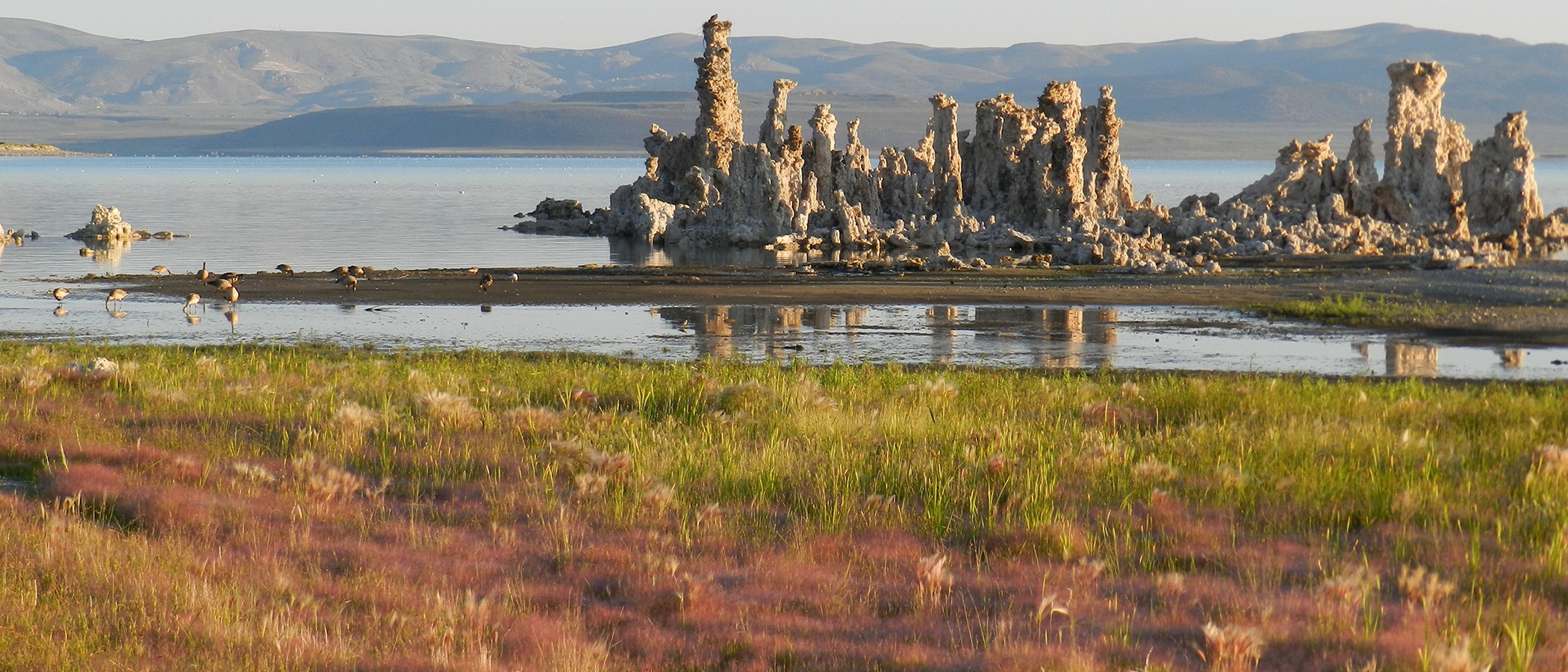
Crowley Lake Reservoir, cradled in the Long Valley Caldera and formed by the damming of the Owens River, offers spectacular views of the High Sierra to the west and the Glass Mountain and White Mountain ranges to the east. Crowley is nestled amid a mix of sagebrush, wet meadows, and small alkali lakes, attracting a variety of breeding and migrant waterbirds. June is the peak of the breeding season, so we should see several species of nesting ducks, shorebirds, and grebes, plus some over-summering non-breeders and late migrants. We will also view a variety of swallow species, enjoy the beautiful song of the Sage Thrasher, the subtle beauty of the Brewer’s Sparrow, and if we are really lucky, run into some Bi-State Greater Sage-Grouse. Bring snacks, water, sunscreen, and layers.
Date: Sunday, June 21
Time: 6:00am-11:30am
Instructor: Jon Dunn
Meeting location: CCF A
Difficulty rating: easy
Driving distance: 80 miles
Haven’t had enough yet? Jump on board with other hardcore birders to try and re-find any rare birds detected by other field trips throughout the weekend. Route and locations entirely dictated by any vagrants, so fingers crossed for some exciting and unexpected birds!
Date: Sunday, June 21
Time: 6:00am-11:00am
Instructors: Chris McCreedy & Forrest English
Meeting location: CCF B
Difficulty rating: difficult
Driving distance: up to 140 miles
Wildrose Canyon is an isolated riparian corridor and aspen grove in the Glass Mountain Range that hosts a variety of awesome species along its mile-long stretch—Calliope Hummingbird, Plumbeous Vireo, Cooper’s Hawk, MacGillivray’s Warbler, Dusky Flycatcher, and Lazuli Buntings are some species you may see. There is a chance to see (or hear) the elusive Virginia’s Warbler. We’ll focus on intermediate-advanced aural and visual birding skills, behavioral observation skills, and natural history of the species we encounter. Be prepared for potentially rugged and uneven terrain, as the unmaintained dirt road often washes out with spring runoff. Join Will on a walk up this gem of a canyon—it’s worth the drive! Bring water and sun protection, as well as snacks or lunch.
Date: Sunday, June 21
Time: 6:00am-10:30am
Instructor: Tom Hahn
Meeting location: CCF C
Difficulty rating: easy
Driving distance: 20 miles
This half-day trip will explore the habitats and avifauna of the subalpine zone of the nearby Sierra. Areas we’ll explore include both Lower and Upper Virginia lakes, Virginia Lake Resort, Trumbull Campground and lake, and short trails nearby. Habitats include lodgepole pine forest; aspen and willow riparian and associated wet meadows; lakeshores and open water, and adjacent sagebrush-steppe. We’ll continue drive as far as 9800 feet and may walk up to about 10,000 feet. We hope to see a diverse assemblage of birds, and the scenery should be memorable. Species we may encounter include Western Tanager, Mountain Chickadee, Fox Sparrow (“Thick-billed” subspecies), and more. If luck is with us, we may see more elusive species like Western Flycatcher, Red Crossbill, or Gray-crowned Rosy-finch.
Date: Sunday, June 21
Time: 6:00am-11:30am
Instructor: AnnaLisa Mayer
Meeting location: CCF D
Difficulty rating: moderate
Driving distance: 40 miles
Join us for a scenic bird walk along Green Creek, a tributary of the East Walker River that originates at the crest of the Sierra, marking the boundary of Yosemite National Park. As we meander through the dappled light of the riparian forest, we’ll be on the lookout for an array of colorful characters. We will keep our eyes peeled for Green-tailed Towhees, Steller’s Jays, orioles, tanagers, and many more vibrant species! This location also holds historical significance—it was home to one of the nation’s earliest hydroelectric power plants, which played a pioneering role in long-distance electricity transmission. Bordering public lands managed by the BLM, it provides essential habitat for mule deer, black bears, beavers, and a variety of bird species, including the Northern Goshawk and the Bi-State Greater Sage-Grouse.
Date: Sunday, June 21
Time: 6:30am-10:30am
Instructor: Gena Wood
Meeting location: CCF A
Difficulty rating: easy
Driving distance: 46 miles
Join us for a half-day birding excursion in the stunning Lakes Basin above Mammoth Lakes, California. This high-elevation paradise, nestled among towering peaks and pristine alpine lakes, provides a unique habitat for a variety of mountain songbirds, raptors, and waterfowl. We will focus our efforts around Twin Lakes, with its diverse mix of marshy shoreline and open water, willow and aspen riparian, wet meadows, and lodgepole pine and red fir forests. If time allows, we may also explore one or more of Lake Mary, Lake George, or Horseshoe Lake. Birds we’ll likely see include Mountain Chickadee, Warbling Vireo, Ruby-crowned Kinglet, Wilson’s, Yellow, Orange-crowned, Yellow-rumped, and, perhaps, Nashville warbler; Song, Lincoln’s, Fox, and Lincoln’s sparrows; and, with luck, such specialties as Williamson’s Sapsucker and Pine Grosbeak.
Date: Sunday, June 21
Time: 6:30am-11:00am
Instructor: Dave Shuford
Meeting location: CCF B
Difficulty rating: moderate
Driving distance: 70 miles
On this trip we’ll explore recently burned forests through both a scientific and an artistic lens. We’ll discuss exciting, new scientific findings based on searches for nests and Maya will share some of her new poetry along the way. We will look for snag-dependent birds like White-headed, Hairy, Lewis’s, and Black-backed Woodpeckers, Williamson’s Sapsucker and secondary cavity nesters like Mountain Bluebird and Tree Swallow. We’ll discuss the many ways that mixed-intensity fire supports biodiversity and ecological health in our conifer forests, and a habitat created by high intensity fire called complex early seral forest, which is the rarest, most biodiverse, and yet the most threatened of all forest habitat types in the Sierra Nevada. Bring snacks, water, and sunscreen. This trip requires driving on rough and sandy roads and it is recommended to take a 4WD or AWD vehicle with high clearance.
Date: Sunday, June 21
Time: 6:30am-11:30am
Instructor: Maya Khosla
Meeting location: CCF C
Difficulty rating: moderate
Driving distance: 55 miles
What better way is there to spend a morning birding in the Sierra than with the person who wrote the field guide? Join Keith, bird artist extraordinaire, author of the Hansen’s Field Guide to the Birds of the Sierra Nevada, to immerse yourself in the birds of Lee Vining canyon and the lyrical prose of Keith’s species descriptions of the birds you see. Expect to see and learn about montane birds from Mountain Chickadees to Clark’s Nutcrackers and many in between. Bring snacks, water, and sunscreen.
Date: Sunday, June 21
Time: 6:30am-11:00am
Instructor: Keith Hansen
Meeting location: CCF D
Difficulty rating: easy
Driving distance: 16 miles
Lee Vining Canyon is one of the Eastern Sierra’s premier birding locations. It offers a variety of habitats and breathtaking views. Of particular interest is the habitat progression as Lee Vining Creek drains from the high alpine mountains of Yosemite and Tioga Pass down through the canyon and into the arid sagebrush scrub surrounding Mono Lake. American Dipper, Townsend’s Solitaire, Warbling Vireo, Yellow Warbler, and nuthatches are among the many species that we may see. Bring snacks, water, and sunscreen..
Date: Sunday, June 21
Time: 6:30am-11:00am
Instructor: Sarah Stock
Meeting location: CCF E
Difficulty rating: moderate
Driving distance: 6 miles
Come look for birds 9,700 feet above the sea! High in the mountains this 2.5-mile trail winds its way through red metamorphic rocky benches, past blue-green tarns and ruins from the days of the Great Sierra Consolidated Mining Company. Here, some unique birds breed while others pass through on their way to lower elevations. A flurry of development had this region growing from 1882–1884 though no gold was really ever found. Let’s search for the ghosts and see what birds dare to spend summers way up here. Summer residents include Cassin’s Finch, White-crowned Sparrow, Clark’s Nutcracker, Chipping Sparrow, Golden Eagle, Bald Eagle, Williamson’s Sapsucker, Spotted Sandpiper, Townsends Solitaire, and many others. Bring a hat, sunscreen, warm layers, water, and snacks.
Date: Sunday, June 21
Time: 7:00am-11:30am
Instructor: Evan Weissman
Meeting location: CCF A
Difficulty rating: difficult
Driving distance: 22 miles
Spend a morning enjoying birds and other wildlife in one of the Mono Basin’s most spectacular locations—Lundy Canyon. The mixture of aspen-cottonwood-willow riparian habitat with mature conifers provides prime habitat for a variety of Eastern Sierra birds. The awesome scenery, including displays of wildflowers, picturesque historical sites, beaver lodges, butterflies, and breathtaking rocky peaks should provide additional flavor to the outing. We will make a special effort to locate species of breeding birds as well as to locate birds by song. Bring snacks, water, and sunscreen.
Date: Sunday, June 21
Time: 7:00am-11:00am
Instructor: Nora Livingston
Meeting location: CCF B
Difficulty rating: moderate
Driving distance: 25 miles
Located above the town of Mammoth Lakes, Valentine Camp is a 156-acre property managed by the University of California at 8,000–8,500 feet. It has been protected from entry and grazing since the early 1900s and features remarkably pristine sub-alpine habitat. Birdlife is plentiful and varied here, particularly those birds who enjoy mature coniferous forests, mixed montane woodland, and sagebrush expanses. We have been granted special permission to access the property and will hike the private trails through this wonderland.
DIFFICULT HIKING. This trip involves walking on a narrow steep trail with some stairs with an elevation gain of approximately 500 feet. Not appropriate for persons with breathing, vertigo, or mobility concerns. Please wear sturdy hiking shoes. There will be mud. If you normally hike with poles, please bring them. Bring snacks, water, and sunscreen.
Entry to this field trip is done by lottery. Participants are required to sign a waiver of liability before entering the reserve. The last day to enter the lottery is April 3, 2026. You will be notified of results on April 6, 2026. ENTER THE LOTTERY HERE
Date: Sunday, June 21
Time: 7:00am-11:30am
Instructors: Chris and Rosie Howard
Meeting location: CCF C
Difficulty rating: Difficult hiking
Driving distance: 60 miles
Join the panelists from Mono Lake, Owens Lake, Great Salt Lake, and Laguna Mar Chiquita for a follow-up morning in the field. This relaxed outing will build on themes from the previous evening’s films and discussion while exploring Mono Basin birdlife and saline lake ecology.
Date: Sunday, June 21
Time: 7:00am-11:00am
Meeting location: CCF D
Difficulty rating: easy
Driving distance: 22 miles
This unique area, the oldest known gold mining site in the Eastern Sierra, is a quiet, dramatic place unlike any other location in the Mono Basin. A riparian habitat of willow and aspen holds typical breeding species such as Calliope Hummingbird, MacGillivray’s Warbler, and Green-tailed Towhee. Adjacent sagebrush and bitterbrush habitat offers a different group of birds. Rocky expanses and unlimited vistas provide good raptor watching. This is a fun and scenic area with lots of great boulders and old cabins that will interest not only birders, but photographers as well.
The hike includes a small stretch of rock scrambling. People with limited mobility should choose an alternative route to return to the cars.
Date: Sunday, June 21
Time: 7:00am-11:00am
Instructor: David Wimpfheimer
Meeting location: CCF E
Difficulty rating: difficult
Driving distance: 25 miles
Join Greg for a combination driving and hiking tour of the stunning geology of the Mono Basin. From volcanic craters to glacial moraines, massive mountains to tufa towers, the Mono Basin holds some of the most spectacular and accessible geology anywhere in the world. This field trip will present the geologic stories behind such scenic wonders as Mono Lake, the Mono Craters, Lee Vining Canyon, and Tioga Pass. If you’ve ever wanted to know more about what formed the diverse landscapes of the Mono Basin, this trip is for you. Bring snacks, water, and sunscreen.
Date: Sunday, June 21
Time: 7:30am-11:30am
Instructor: Greg Stock
Meeting location: CCF A
Difficulty rating: moderate
Driving distance: 25 miles
Wildflowers abound along the 2.5 mile-loop trail, which runs through a variety of habitats: sagebrush scrub, pinyon woodland, aspen and cottonwood stands, and limestone outcrops. With gorgeous views of the lake and the multi-colored cliffs above, this easy trail is a wonderful place to spend the morning. We will see common wildflowers like wild rose, paintbrush, locoweeds, and evening primrose, as well as a few rare species known from just a couple locations in Mono County. We might even spot a few birds! Wear sturdy shoes. Bring snacks and water. There are bathrooms at the beginning and end of the trail.
Date: Sunday, June 21
Time: 7:30am-11:30am
Instructor: Russell Kokx
Meeting location: CCF B
Difficulty rating: moderate
Driving distance: 65 miles
How do we ensure that the places we love to visit remain vibrant, both ecologically and culturally? This session explores the powerful role sustainable tourism can play in conservation efforts, from travelers who show up with purpose to the local businesses and communities that make meaningful experiences possible. We’ll examine how thoughtful engagement with gateway communities can strengthen the connection between people and the landscapes they come to explore, and why that connection matters for long-term stewardship.
Date: Sunday, June 21
Time: 8:00am-9:00am
Presenter: Brice Esplin
Presentation location: Mono Lake Committee
When the California Supreme Court ruled in 1983 that the Los Angeles Department of Water & Power’s water diversions from the Mono Basin had to be reconsidered to protect Mono Lake, it did so based on the Public Trust doctrine. The court wrote that the Public Trust “is an affirmation of the duty of the state to protect the people’s common heritage of streams, lakes, marshlands and tidelands. The human and environmental uses of Mono Lake—uses protected by the Public Trust doctrine—deserve to be taken into account. Such uses should not be destroyed because the state mistakenly thought itself powerless to protect them.” The Public Trust doctrine has a long and fascinating history on its way to the precedent-setting Mono Lake case and continues to be applied to environmental law today. In this talk, we will walk through the history of the Public Trust Doctrine, how it reshaped environmental law, and what it meant for Mono Lake. The presentation will also include an update on the lake today, current restoration and management efforts, and the roadmap ahead as the Mono Lake Committee continues working to restore and protect the Mono Basin.
Date: Sunday, June 21
Time: 9:00am-10:00am
Presenter: Geoff McQuilkin
Presentation location: Mono Lake Committe
Join writer and geographer Caroline Tracey to discuss her book Salt Lakes: An Unnatural History, a blend of memoir and environmental reportage. Her book travels from the Great Salt Lake to the Aral Sea, across the American West and around the world, in search of these extraordinary vanishing lakes and the people dedicated to saving them. She takes readers along on her adventures by train in Kazakhstan and on an inflatable raft in California, on her encounter with Mormon environmentalists in Utah and an Australian Aboriginal painter seeking to capture her country for her children. In evocative prose, she traces shorebirds’ seasonal migration and the history of water law. As Tracey chronicles the decline of the lakes, she also experiences dramatic changes in her own life and conception of self. Running parallel to Tracey’s environmental journey is an intimate, human one: her story of finding queer love and building a home in a world fast being remade by ecological crises. By the end of Salt Lakes, she shows us how seeing the environment through a queer lens could help save our water system.
Date: Sunday, June 21
Time: 10:00am-11:00am
Presenter: Caroline Tracey
Presentation location: Mono Lake Committee
Art, in the form of nature journaling, is one crucial way of documenting our surroundings in the face of climate change or changes proposed or implemented by the current administration. Journal documentation takes on a new level of importance and urgency and serves as proof in ways that written papers or sound bites can’t. This trip will take place in several locations such as lakeside habitats, meadow habitat, canyons, ruderal zones, and others. Your observational skills will be honed and your connection to nature deepened as we view and discuss what we see. Field journaling and art techniques include using watercolors, pencil or pen and journal, digital or phone cameras, even written or recorded words. Be sure to bring your preferred portable journaling supplies, a hat, sunscreen, snacks and water—and a sense of wonder.
Date: Sunday, June 21
Time: 8:00am-11:30am
Instructor: Sue Jorgenson
Meeting location: CCF A
Difficulty rating: Easy walking: 2 miles
Driving distance: 25 miles
We will take a leisurely hike through open sagebrush to the mouth of Rush Creek where we will enjoy a unique perspective of the Mono Basin. Along the way we will pause to study birds typical of the Great Basin Desert habitat, including Brewer’s Sparrow, Sage Thrasher, and possibly Sagebrush Sparrow. Once at the delta we will experience an awesome setting while watching birds come in to bathe in the fresh water of the largest tributary stream that feeds Mono Lake. There is little shade on this walk. Bring sunscreen and a hat, as well as snacks and water.
Date: Sunday, June 21
Time: 8:00am-11:30am
Instructor: Susan Steele
Meeting location: CCF B
Difficulty rating: Moderate; 2 miles hiking
Driving distance: 20 miles
Head out early with your binoculars and a camp chair and let the birds come to you! Your leaders will pick a spot with a variety of habitats and views and the group will spend this leisurely trip sitting in one spot and identifying all the birds that come through. You may learn which individuals have built a nest nearby, or who is fighting for territory, while you pay careful attention to the birds within your field of view. Bring snacks, water, and a chair or stool.
Date: Sunday, June 21
Time: 8:00am-11:00am
Instructor: Mary Clapp
Meeting location: CCF C
Difficulty rating: Stationary activity
Driving distance: 15 miles
We will drive to South Tufa where we will walk to Mono Lake to view active Osprey nests, discuss why a fish-eating bird is living at a fishless lake, and talk about Osprey natural history. South Tufa is the best area to view active nests and if we are lucky the chicks will be large enough to offer us a glimpse. Updates to the current research will also be discussed, which includes some dispersal, migration, and local foraging data thanks in part to Chautauqua grants for banding and telemetry study. We may adjust our route (and possibly our location) based upon current Osprey activity. We will be in exposed areas without shade. Please bring a hat, sunscreen, snacks, and water.
Date: Sunday, June 21
Time: 8:30am-11:30am
Instructor: Lisa Fields
Meeting location: CCF A
Difficulty rating: easy
Driving distance: 22 miles
This family-friendly trip is a great introduction to birding for all ages. In this trip, we’ll go over some basic binocular information, practice using this equipment, and check out some different bird guides. As we wander outdoors, we’ll look at some of the more common birds in and around Mono Lake, practice identifying them, and learn about their fascinating natural history. We should see several varieties of woodpeckers, songbirds, swallows, and blackbirds. Bring snacks, water, and sunscreen.
Date: Sunday, June 21
Time: 9am-11am
Instructor: Catherine Jones and Avila
Meeting location: CCF B
Difficulty rating: easy
Driving distance: 10 miles