This post was written by Caelen McQuilkin, Project Specialist, and Teri Tracy, Eastern Sierra Policy Coordinator.
After months of wet weather, Californians are embracing some welcome news. According to the US Drought Monitor’s five-level scale, there are no areas of drought in the state for the first time in 25 years.
This information was well received at a January Los Angeles Board of Water & Power Commissioners meeting. Senior Assistant General Manager for the Water System, Anselmo Collins, referred to the drought-free conditions as “quite outstanding,” and a commissioner described the status as “unbelievable.”
Yet these remarkable water conditions have made no difference in DWP’s water export operations from the Mono Basin so far.
Beyond the drought-free news, water reservoir supplies bolster this positive outlook. While water observers keep a watchful eye on snowpack and conditions across the West, they are celebrating reservoir levels in California. Statewide, all major supply reservoirs sit above their historical averages. In Southern California, all major reservoirs are either at full capacity or above their historical average. For example, the Diamond Valley Reservoir, the biggest in Southern California, currently sits at 129% of its historical average. In a January 9 Los Angeles Times article, University of California Agriculture and Natural Resources climate scientist Daniel Swain said, “there is likely no need to worry about the state’s water supply for the rest of year.”
In addition, LA’s investments in increasing local supply resilience are paying off. In Collins’ January 13 report to the DWP Commissioners, he reported that almost 56,000 acre-feet of stormwater has been captured since October 1, 2025. That is more than triple the amount of water exported from the Mono Basin and is enough water to serve approximately 223,000 homes in Los Angeles for an entire year.
Yet these remarkable water conditions have made no difference in DWP’s water export operations from the Mono Basin so far. Despite DWP’s agreement to raise Mono Lake to a healthy level—and the lake being ten feet short 30 years after the mandate—DWP’s diversions continue as usual. The Mono Lake Committee’s export counter shows exports since the beginning of October are now close to 12,000 acre-feet out of the maximum 16,000 acre-feet technically allowed this year.
DWP claims its management “begins with prioritizing the environment and the watershed in the Mono Basin first before a single drop reaches the City of Los Angeles,” as written in its January 2026 newsletter. But the department’s actions show otherwise. In this moment when good conditions could allow for a voluntary reduction in diversions from Mono Lake’s tributaries, DWP’s current initiatives align closer with their standard Eastern Sierra policy: “We always try to maximize aqueduct deliveries to the city,” DWP officials told CalMatters last year.
In 2024, DWP broke Mayor Karen Bass’ promise to limit water diversions to 4,500 acre-feet. At that time, DWP’s aqueduct manager pointed to recent dry months as an important factor in the decision to divert more acre-feet than originally planned. DWP “review[s] current hydrological conditions, available storage within the aqueduct system as well as environmental conditions,” they said in a January 2025 CalMatters article. DWP said it adjusted the diversion plan citing dry hydrological and environmental conditions. Yet so far there is no commitment to doing the same and lowering diversions in wet conditions. Meanwhile, due to DWP’s surface and groundwater exports, forecasts for the end of March 2026 show that Mono Lake will be about half a foot lower than it would have been with no exports.
As the export counter ticks up, the Committee is watching for DWP’s snow survey results, forecast, and Annual Operations Plan. For now, DWP continues business as usual even though conditions are ripe to, as it claims, prioritize the “environment and the watershed.”
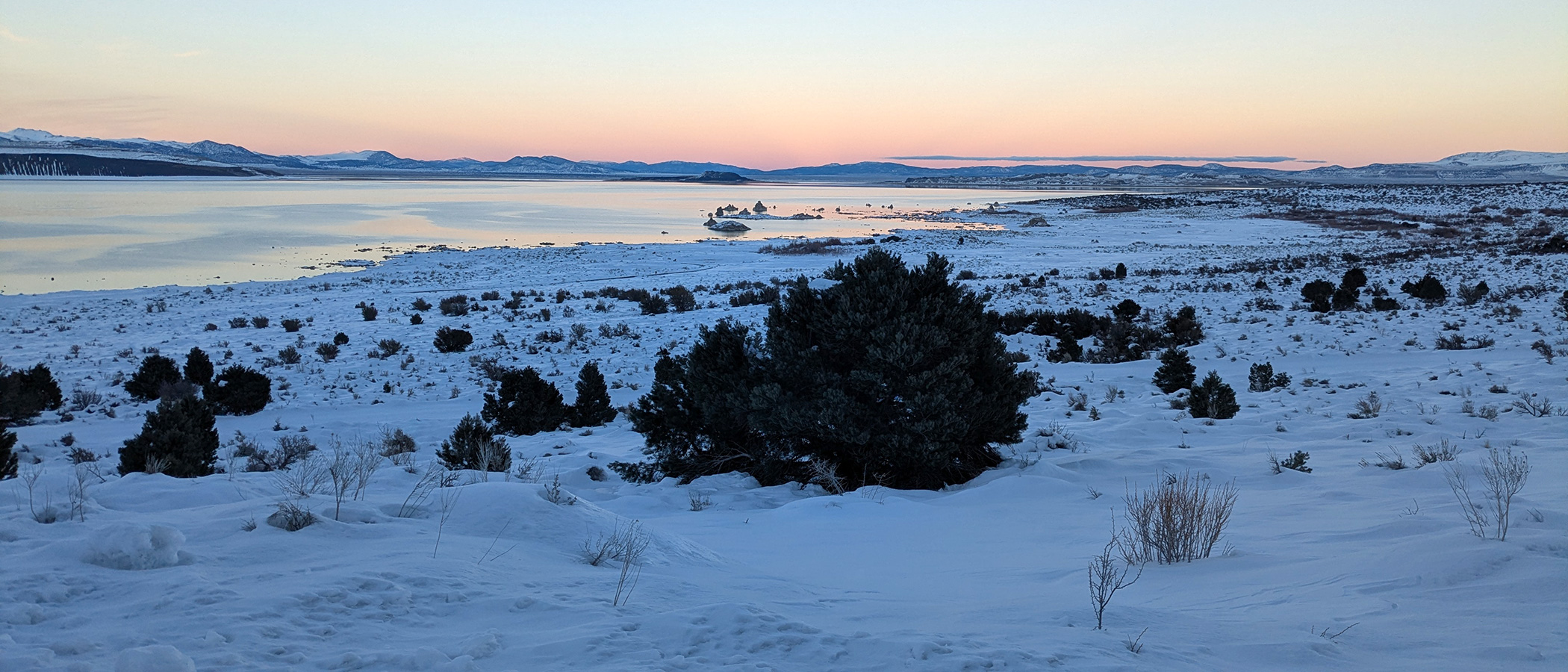
Top photo by Robbie Di Paolo: The Mono Basin was blanketed in snow on January 7, 2026, after heavy storms at the end of 2025.
What can be done to limit diversions?