
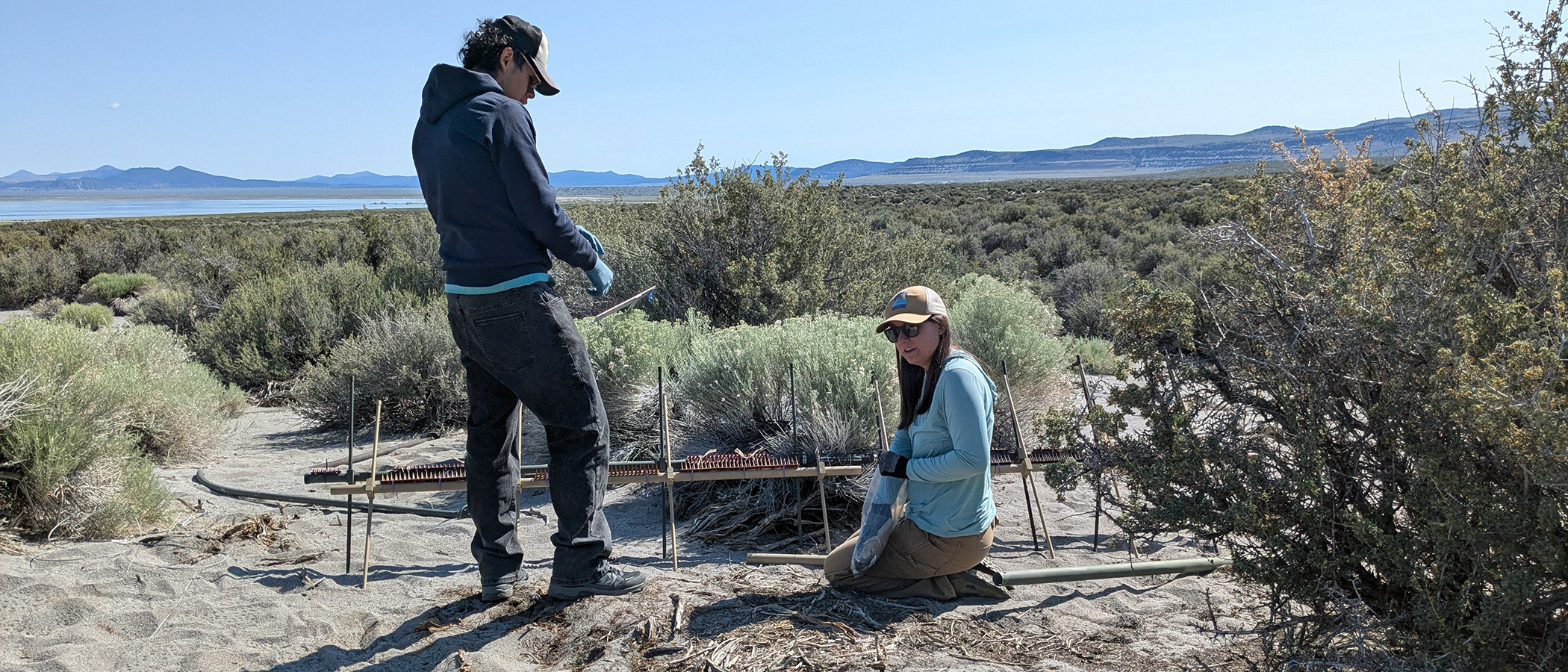
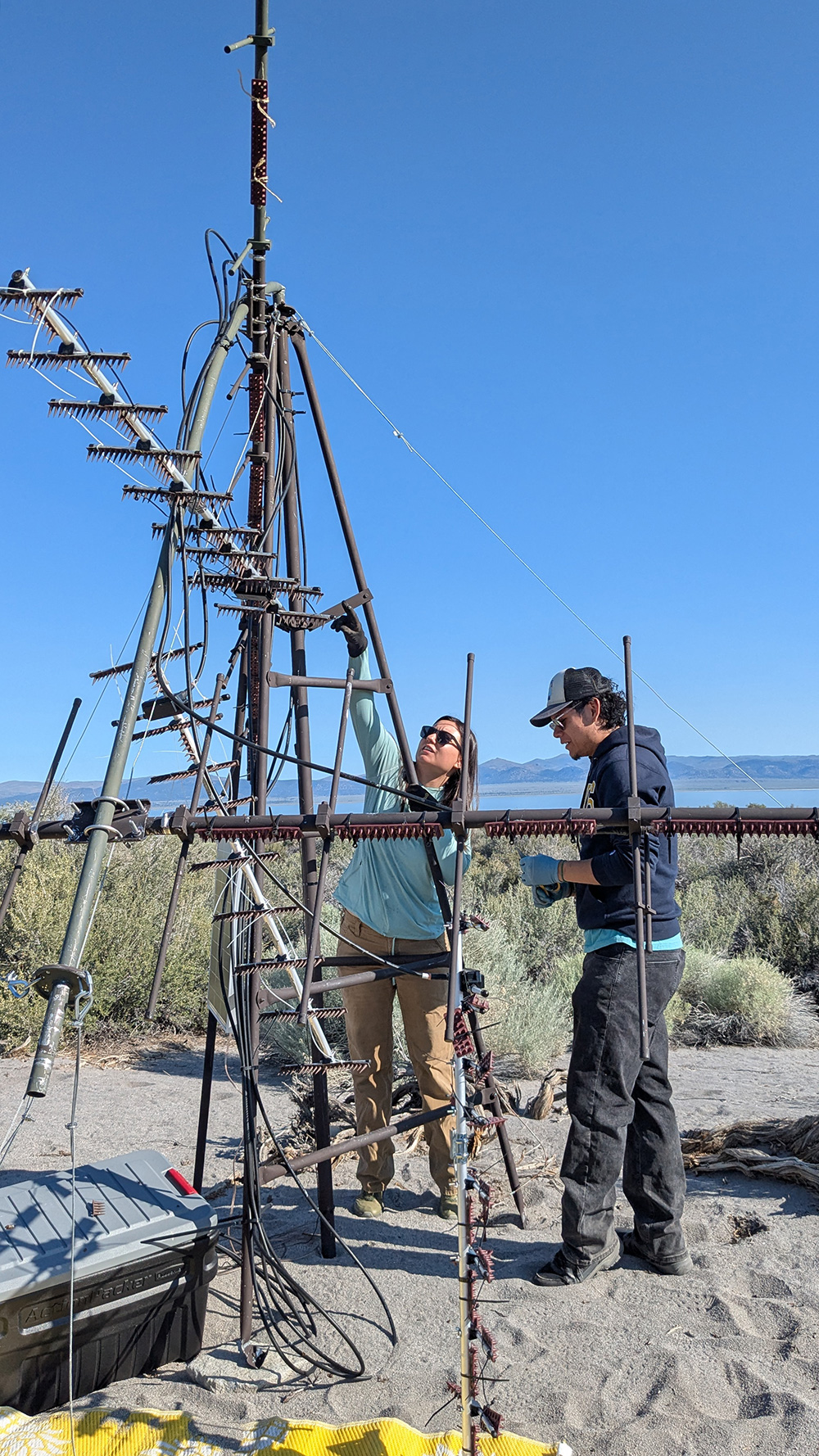
2026 was the Mono Lake Committee’s fourth year managing Motus wildlife tracking stations at Mono Lake. The Committee’s three stations have helped detect and track the movements of 15 Red-necked Phalaropes and five Wilson’s Phalaropes tagged at Mono Lake. Additionally, Mono Lake stations have contributed migration data for two American White Pelicans tagged at Great Salt Lake, a Swainson’s Thrush and a White-crowned Sparrow each tagged in British Columbia, a Common Poorwill tagged in Montana, and a Purple Martin tagged in Oregon.
Motus stations work independently to detect lightweight radio tags attached to small birds, bats, and even flying insects. All detections are transmitted to an international research collaboration called the Motus Network, which is designed to detect and share the locations and movements of wildlife over any distance, whether that’s across the state or across hemispheres.
Oikonos Ecosystem Knowledge, a conservation non-profit which has been conducting phalarope research at Mono Lake since 2019, worked with the Committee to help design the Mono Lake Motus system. While implementing and maintaining Motus at Mono has not been an easy task due to the Mono Basin’s harsh conditions, the data has already contributed meaningfully to our understanding of phalaropes at Mono Lake. A surprising example includes a Red-necked Phalarope tagged at Mono Lake in 2025 that flew straight over the Sierra crest and was detected a little more than two hours later and 136 miles away in the Panoche Hills between Monterey and Fresno. This year, we’ve been able to track a Wilson’s Phalarope to the Colorado River south of Las Vegas, then to a coastal lagoon near the middle of the Gulf of California, and later to a reserve at the Colorado River Delta in the northern Gulf of California.
These two birds alone were tracked thanks to 23 different Motus stations spread across California, Arizona, and Mexico, including three at Mono Lake. But despite different station managers and research interests, the Motus network helps us help one another. A Motus station designed to track monarch butterfly migration near Santa Barbara can also detect a Mono Lake Red-necked Phalarope. And in doing so, the organisms we track show us how faraway ecosystems, and the need for habitat conservation, are connected.
Tagging phalaropes
To learn about the process of tagging phalaropes at Mono Lake—which is difficult!—you can watch this ten-minute presentation from Oikonos Science Director Ryan Carle:
Ryan Carle on Phalarope Migration | 2026 Pacific Seabird Group Meeting
This post was also published as an article in the Fall 2026 Mono Lake Newsletter. Top photo by Robbie Di Paolo.