On June 25, six science experts on Mono Lake’s California Gulls, Eared Grebes, phalaropes, shorebirds, and waterfowl presented the State Water Board with data and trends they’ve observed in bird populations since the Board’s 1994 decision to raise Mono Lake.
One by one the researchers told a familiar story—raising Mono Lake to the mandated 6,392-foot level would meaningfully improve food availability, habitat, and protection from predators for the globally significant bird populations that increasingly depend on Mono Lake as other regional saline lakes collapse.
But they didn’t just tell the same old story. Their studies bring new insights into the dynamics of the critical connections between Mono Lake and other saline lakes. As regional saline lakes shrink or dry up, the importance of Mono Lake for birds has increased.
While the reports on bird populations are, at times, bleak, there are examples of bird populations responding positively in response to lake level rise. This indicates that it is not too late for the birds, and that if water diversion rules are changed swiftly to allow Mono Lake to rise, rebounds in bird populations are likely.
The workshop was the second in a series the State Water Board is holding in order to gather information on the condition of Mono Lake’s public trust resources and potential management options in preparation for a hearing to determine whether Mono Basin water diversions should be modified to reach Mono Lake’s legally mandated water management level. You can find a summary of the first workshop here.
The State Water Board has long used bird population health as a proxy for Mono Lake’s ecosystem health, and the scientists presented fascinating insights into effects of the prolonged delay in achieving the healthy mandated lake level of 6,392 feet above sea level. We have summarized the key takeaways from the presentations below but highly recommend watching the full presentations for the full story.
Migratory shorebirds on the Pacific Flyway
Blake Barbaree of Point Blue Conservation Science gave some context on Mono Lake’s place in the broader hemispheric wetland network as it relates to bird populations. Thanks to bird surveys along the flyway and over time, we can see how damage to one saline lake significantly affects the number of birds seen at other saline lakes. Mono Lake is an essential node in the Pacific Flyway, providing refuge when other nodes decline or dry up.
Barbaree showed estimates of shorebird populations declining by one third over the last 40 years across North America, with the vast majority of species having a declining trend. However, when habitats are restored, the bird populations show resilience.
“There are broad-scale declines across many of these species and within the interior West. This highlights the functional decline of this network. When conservation actions and water management is strategic to potentially help wildlife and groundwater recharge, we see the birds returning and we see them finding these habitats and the conservation networks are now in place to both monitor and understand change over time, but also bring the information and science down to the people managing and working on the ground as well.”
—Blake Barbaree, Point Blue Conservation Science, Workshop 2
Phalaropes, flies, and habitat
Ryan Carle of Oikonos Ecosystem Knowledge explained that the main concern when it comes to phalaropes is overall saline lake habitat loss. “Other key saline lake sites are being threatened with ecosystem collapse, which is increasing Mono’s importance.”
Mono Lake is not just a migratory stopover, it is a staging site, which means the birds rely on it for additional resources essential for their migration. Mono’s abundant and reliable alkali flies draw a large concentration of the world’s population of Wilson’s Phalaropes.
“Would accelerating the progress toward reaching that 6,392′ lake level benefit the status of phalaropes? My answer is yes, because other vitally important staging sites are in danger of collapse or really have already collapsed in some cases and have bounced back but may collapse again soon. And that leaves Mono Lake as the only reliable large staging site.”
—Ryan Carle, Oikonos Ecosystem Knowledge, Workshop 2
Carle referenced Dr. David Herbst’s workshop presentation on alkali flies and how the relationship between lake level, salinity, and habitat that affects fly reproduction is directly connected to food availability for the phalaropes. “That lake level [6,392′] would benefit the production of alkali flies, according to Dr. Herbst, and that would provide more food for phalaropes.”
Carle also talked about the protection status of Mono Lake as it relates to the petition to list Wilson’s Phalaropes under the Endangered Species Act. “There are five criteria for listing a species under this act and the phalaropes aligned with two of them. One is the imminent loss of habitat across a major portion of its range that could cause it to become endangered in the foreseeable future, AKA Great Salt Lake and Lake Abert drying up, or the prospect of that happening. And two, the lack of a regulatory mechanism to protect the species and its habitat. I want to emphasize here that of all that network … Mono Lake is the only one with a regulatory mechanism for addressing water diversions and the amounts of water that flows in and out. No other lake has that legal governance ability to adjust how much water is going in or out.”
Waterfowl and shorebird population dynamics
Mono Basin Waterfowl Habitat Restoration Program Director, Dr. Matthew Reiter, reported on waterfowl population trends that largely echo the overall bird population declines reported by the other experts, with some variation among different waterfowl species and population trends needing more data.
The State Water Board identified waterfowl as disproportionately impacted by lake level decline and created Restoration Order 98-05 specifically to monitor and address these impacts. Wetland development requires a more stable lake level, but monitoring the waterfowl populations is critical to this aspect of the Los Angeles Department of Water & Power’s (DWP) required restoration at Mono Lake.
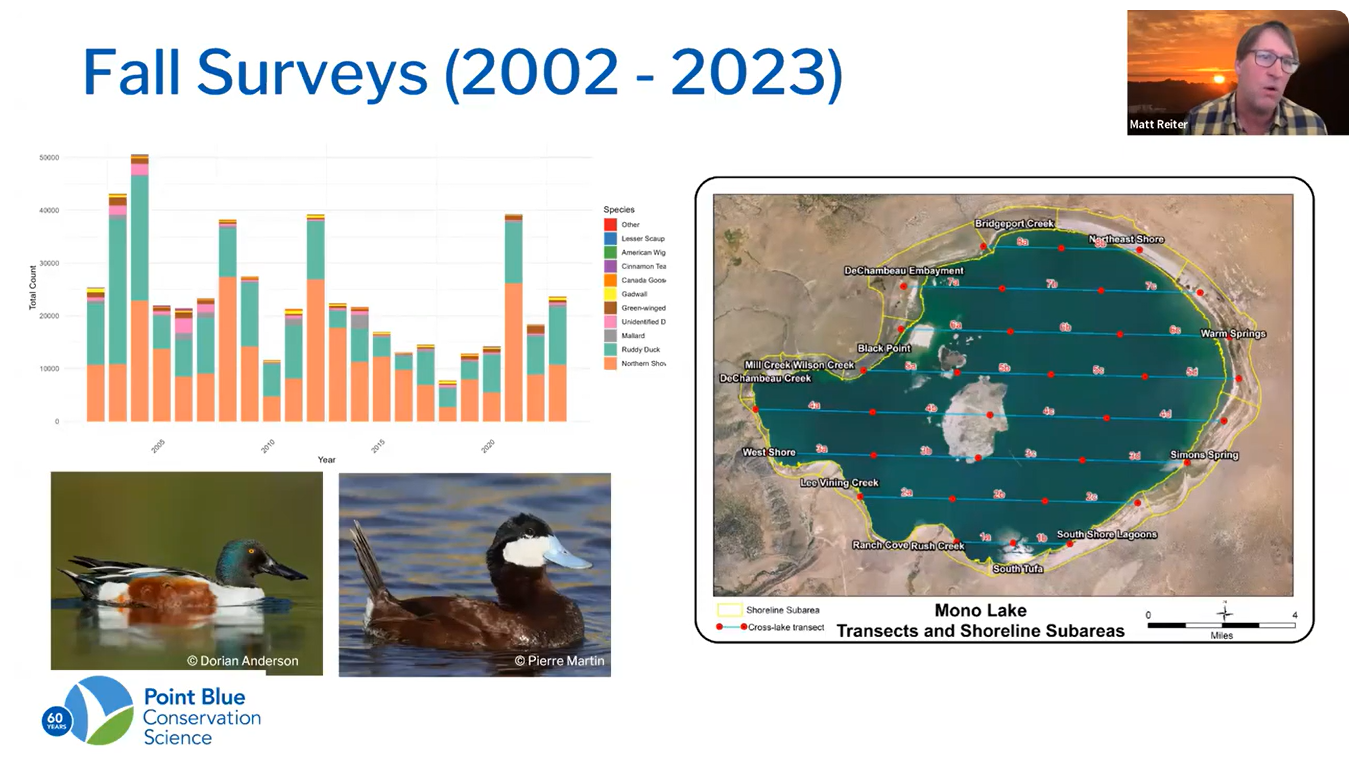
Dr. Reiter’s presentation was a reminder of the stunning effects on wetland habitat at Mono Lake due to excessive DWP water diversions. In 1948 an estimated 170,000 to over 1,000,000 ducks were reported using Mono Lake during fall migration.
“The other thing I just wanted to highlight as well is that if you look at the tallest bar, that correlates with about 50,000 birds in total counted during the fall surveys. So that’s six surveys resulting in a total of 50,000 ducks being counted. That is much lower than the hundreds of thousands to well over a million ducks that were observed by Dombrowski in [19]48. Granted, that was a single data point, but I will highlight that is a pretty big change if we think about that as an 80-year change, if you will, in ducks in the basin.
—Dr. Matthew Reiter, Mono Basin Waterfowl Habitat Restoration Program, Workshop 2
Gull population decline at Mono Lake
Ryan Burnett of Point Blue Conservation Science’s report on the California Gull population at Mono Lake was bleak. “California Gulls’ nesting population at Mono Lake has been in pretty steep decline, in particular in recent years … on average across the 43 year study, we’ve lost 353 nests per year. And that is a highly significant trend … the early [19]90s represented the highest gull population with a pretty steep decline and then in particular in the last decade a strong decline.”
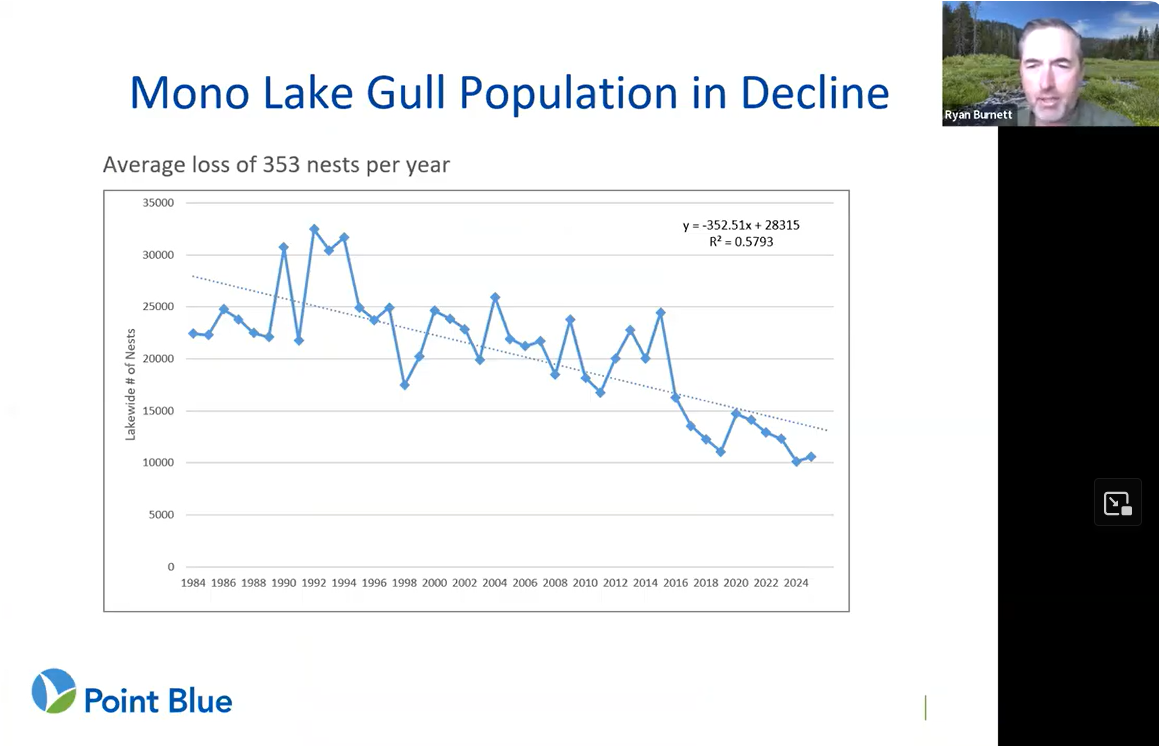
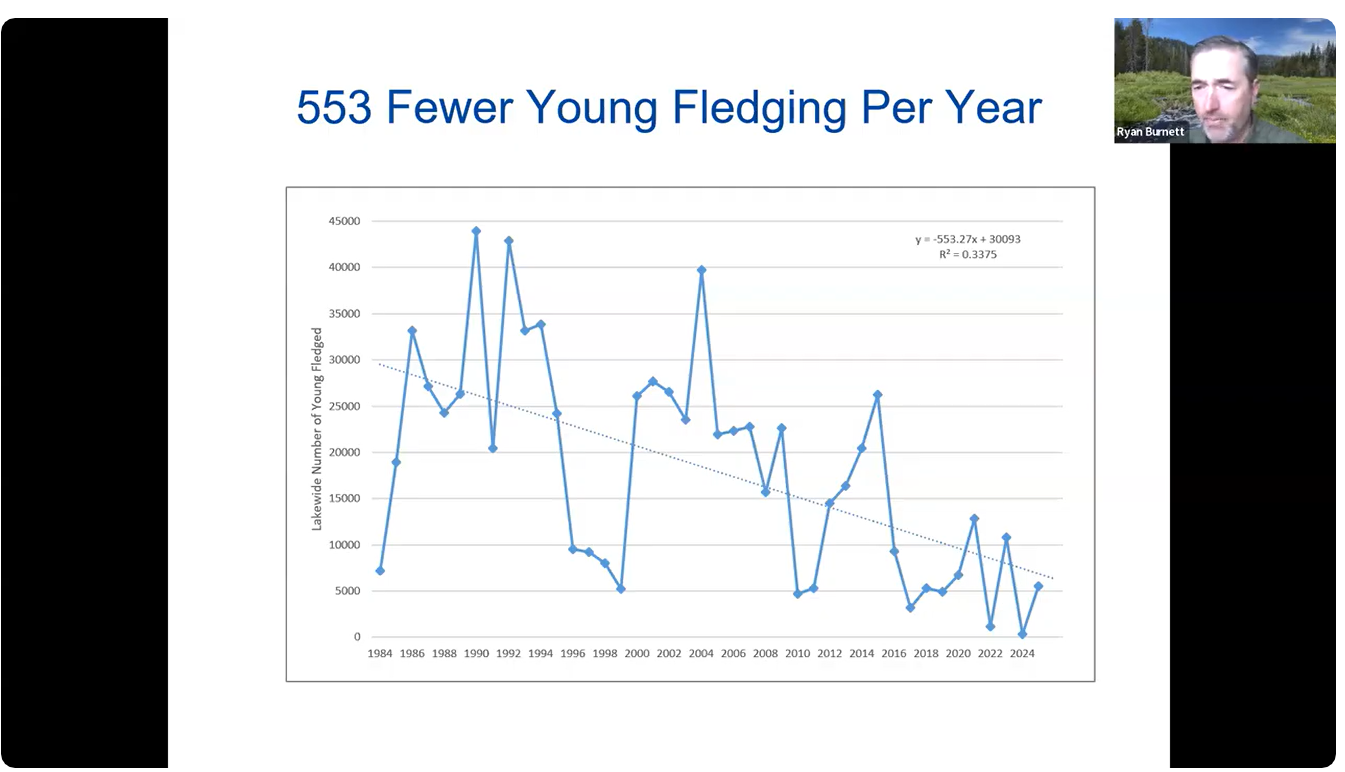
In addition to the decline in numbers, the data also shows a decline in the ability of the population to rebound in periods when conditions are better.
“When we have good productivity years they’re not as good as they used to be and when we have bad productivity years, they’re worse. In fact, in 2022 and 2024, we had the two worst productivity years at Mono Lake with 2024 representing almost a complete population breeding failure at Mono Lake.”
—Ryan Burnett, Point Blue Conservation Science, Workshop 2
Burnett and his colleagues did an analysis of all the factors that influence chick production and found the greatest threat to be terrestrial predators, namely, coyotes. “Once the Negit Islets are accessible to terrestrial predators, there’s really nowhere else for the gulls to nest on the islets, it is their last refugia from terrestrial predators at Mono Lake.” While there are also concerns about the effects of declining productivity and size of brine shrimp, the biggest issue for the gulls is raising the lake enough to permanently cover the landbridge.
Burnett also explained how Mono’s protection is connected the California Department of Fish & Wildlife’s Species of Special Concern list. “Mono Lake is critical habitat for this species. Even though the population is in decline, it’s a protected place. It has a mechanism to maintain water levels unlike many of these other places where there’s unregulated diversion of water. Mono Lake is one of the better places to manage for this species. The California Gull was removed from the California bird species of special concern list … because there was a Bay Area population that had been established and was rapidly increasing and that Mono Lake had protections that would … raise the lake level to protect this species long-term. That really was the justification to remove this species from the list. So, maintaining water levels at Mono Lake for this species is critical to their long-term population viability in the state of California.”
A conservation conundrum
Dr. Nathan Van Schmidt with the San Francisco Bay Bird Observatory showed data on how Mono Lake not reaching the lake level mandate has detrimental and expensive spillover effects in the San Francisco Bay.
The shifting population of California Gulls from Mono to the Bay, believed to have been initiated in the 1980 when the Mono Lake colony was breached by coyotes via the landbridge, has complicated the South Bay Salt Pond Restoration Project. This project is the largest tidal marsh restoration project on the US Pacific Coast, and is working to protect disadvantaged communities from sea level rise by restoring natural systems.
The problem is that California Gulls don’t historically breed in the Bay, but they do now. As voracious nest predators, the large number of California Gulls negatively impacts native nesting water birds, including species listed as threatened and endangered.
“We’re really facing a conservation conundrum here … We have these low-lying subsided disadvantaged communities that are at extreme risk from sea level rise that we need to build tidal marsh to protect. We have a lot of other native water birds that are already trying to make use of a smaller and shrinking number of habitats as a result of that tidal marsh restoration as we’re losing pond habitats. And the connections between Mono Lake and these other struggling saline lake ecosystems are making those decisions much more complicated.”
—Dr. Nathan Van Schmidt, San Francisco Bay Bird Observatory, Workshop 2
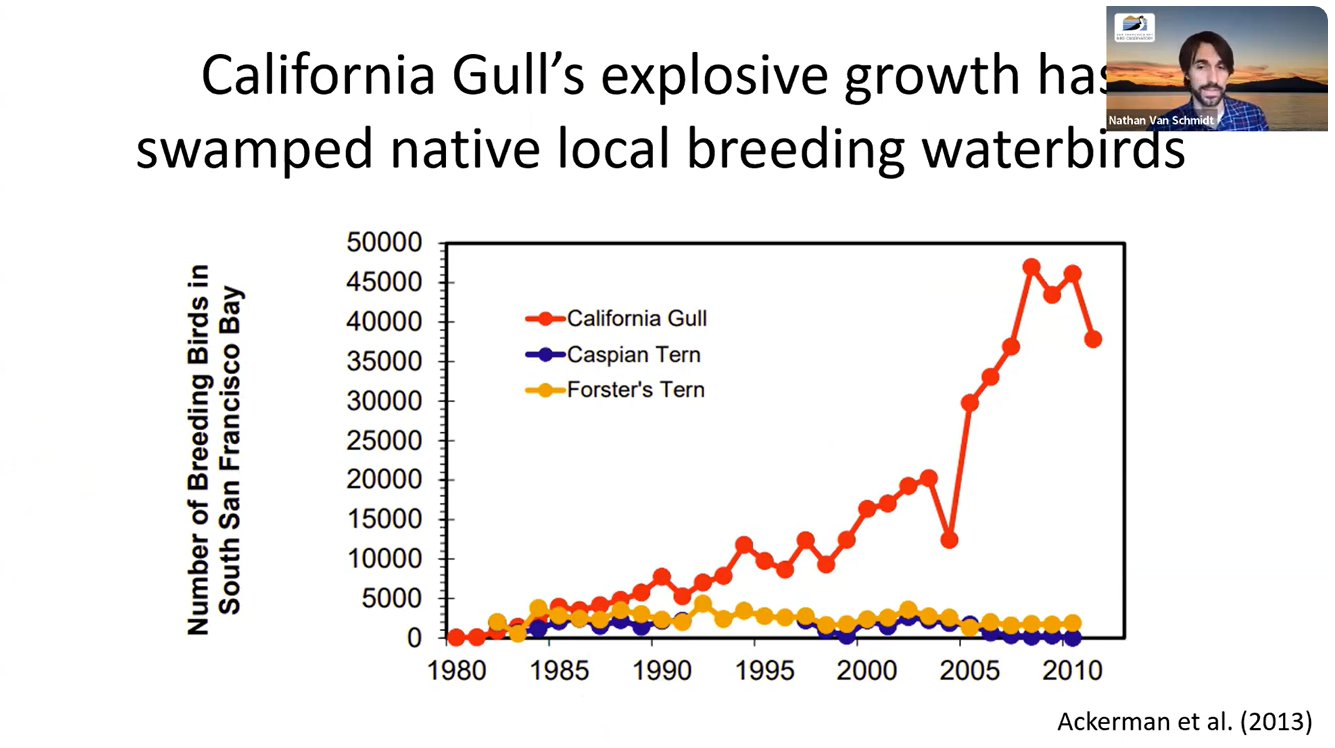
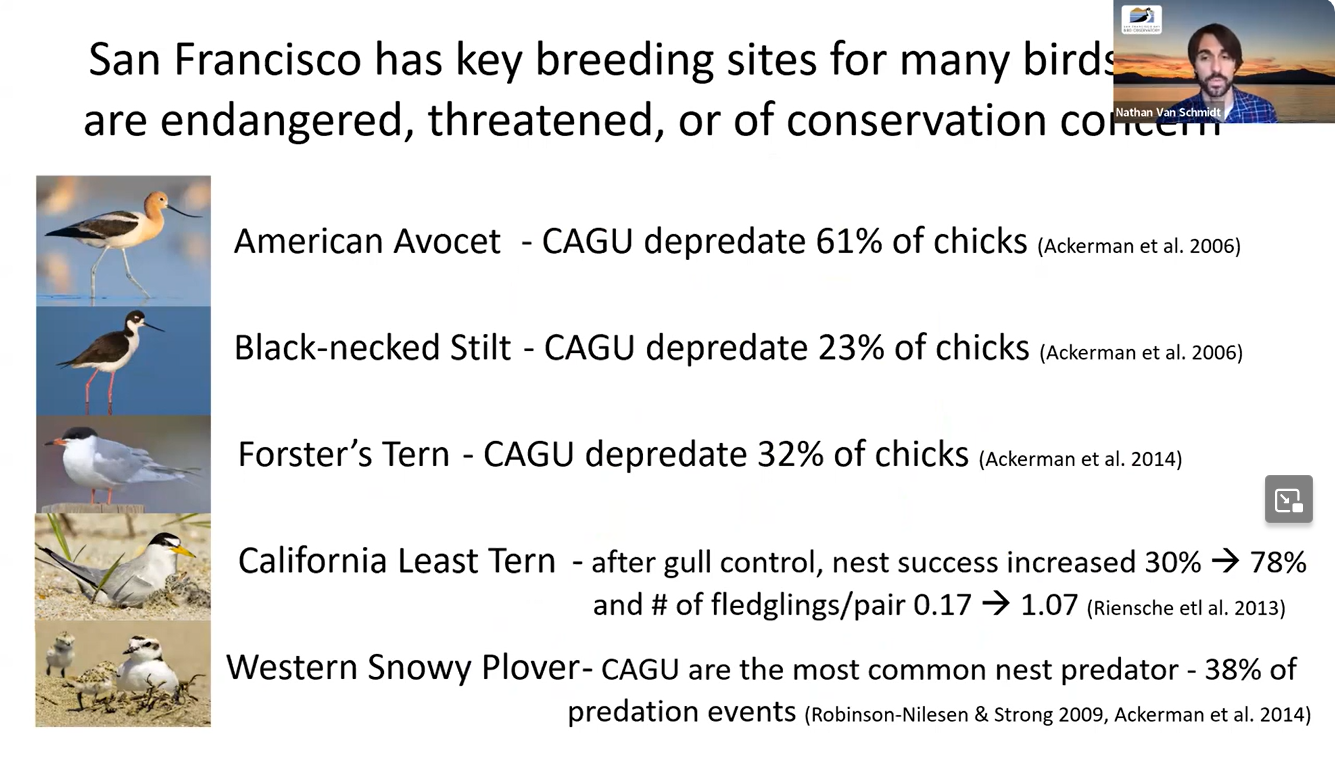
“We’re not really sure how to be managing this, if we should continue treating these birds as a problem if they’re in crisis elsewhere else, and how to balance out those needs. So, in order to do that, I think having good native habitat that is solid would certainly help that situation so that we’re not relying on habitat that they’re not native to help support these species.”
—Dr. Nathan Van Schmidt, San Francisco Bay Bird Observatory, Workshop 2
Of Eared Grebes and shrimp
Dr. Sean Boyd, Research Scientist Emeritus of Environment & Climate Change Canada, explained that Eared Grebes are unique in that 90% or more of the entire population the species uses just two lakes, Mono Lake and the Great Salt Lake, as staging sites to molt their body and flight feathers during their southbound migration for the winter. While the distribution of the birds between the two lakes varies, one-quarter to one-third of the entire population of Eared Grebes have depended on Mono Lake to survive migration.
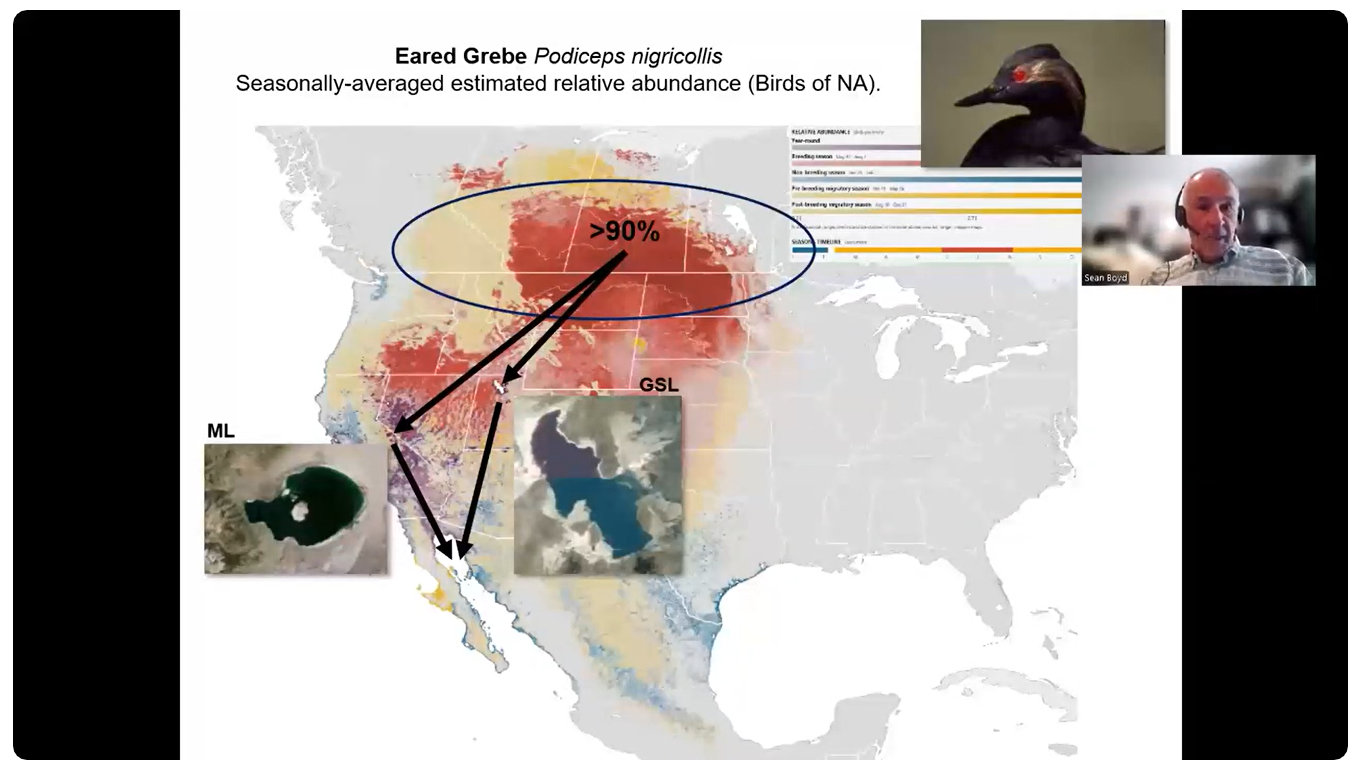
Eared Grebes forage primarily on brine shrimp, which they eat in large numbers to accumulate the fat and protein reserves needed to grow a whole set of new feathers and fuel their migration to wintering areas in and around the Sea of Cortez.
Boyd emphasized the importance of the health of the Eared Grebes when they leave Mono Lake. The birds need to be in good condition, which Boyd’s research has found is correlated to shrimp density. He studied the grebe population as it relates to brine shrimp abundance records and has found a critical shrimp density below which the grebes will not gain weight or molt, and may depart Mono Lake early.
In addition to low shrimp densities, the grebes are also affected when Mono Lake is green into the fall. The low lake transparency makes it difficult for the grebes, who are visual foragers, to find shrimp.
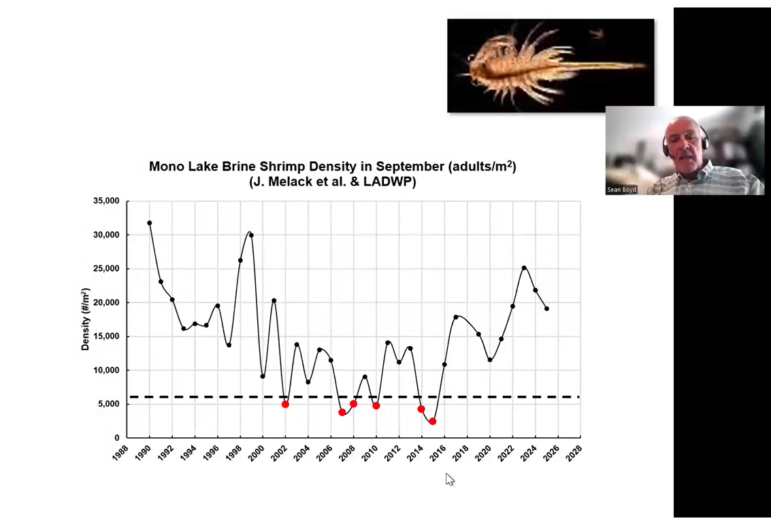
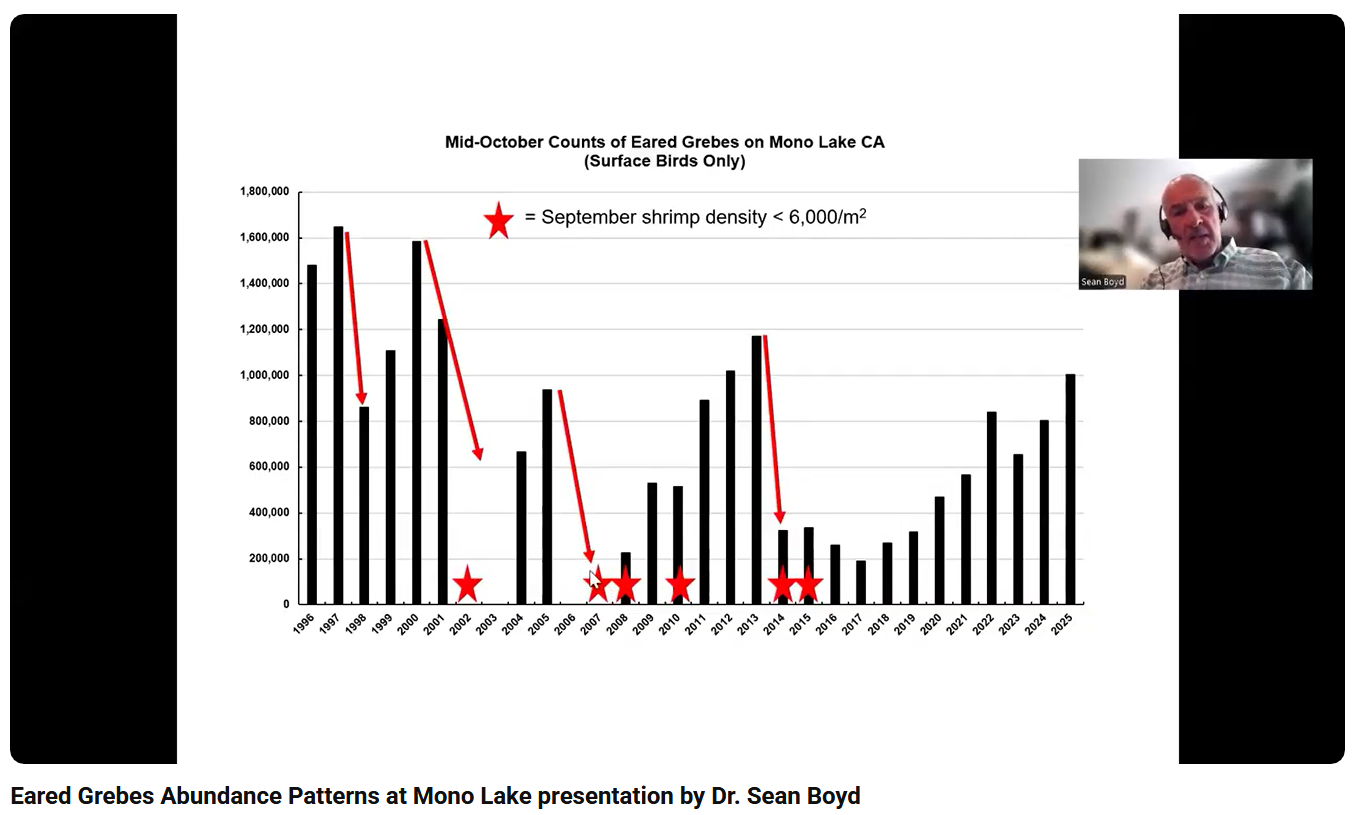
Boyd explained the strong association between shrimp density and Eared Grebe abundance patterns—showing data on years when the brine shrimp densities were below the critical threshold and how those correlate to crashes in the number of grebes on Mono Lake. “A higher lake elevation towards the mandated level will lead to lower salinity levels and higher shrimp levels which will ultimately lead to not just more grebes, but maybe more stable populations of grebes and grebe populations not crashing …”
The science shows urgency
During the workshop the experts brought complex science into focus for the State Water Board. The solution to myriad issues remains clear and familiar. The State Water Board’s original lake level compromise (6,392′) remains essential to the Board’s duty to protect the Public Trust. If anything, the science shows the need to raise the lake has only become more urgent in the last 32 years.
A full recording of the Workshop is available here: Workshop 2
- Blake Barbaree, Point Blue Conservation Science (12:05)
- Ryan Carle, Oikonos Ecosystem Knowledge (33:43)
- Dr. Matt Reiter, Waterfowl Director for the Mono Basin Waterfowl Habitat Restoration Program, Point Blue Conservation Science (57:33)
- Ryan Burnett, Point Blue Conservation Science (1:42:24)
- Dr. Nathan Van Schmidt, San Francisco Bay Bird Observatory (2:02:19)
- Dr. Sean Boyd, Environment & Climate Change Canada (Dr Boyd’s presentation had to be done on another day, so this link goes directly to that presentation and is not included in the main link)
- Q & A (2:21:55)
A full recording of Workshop 1 is available here: Workshop 1.
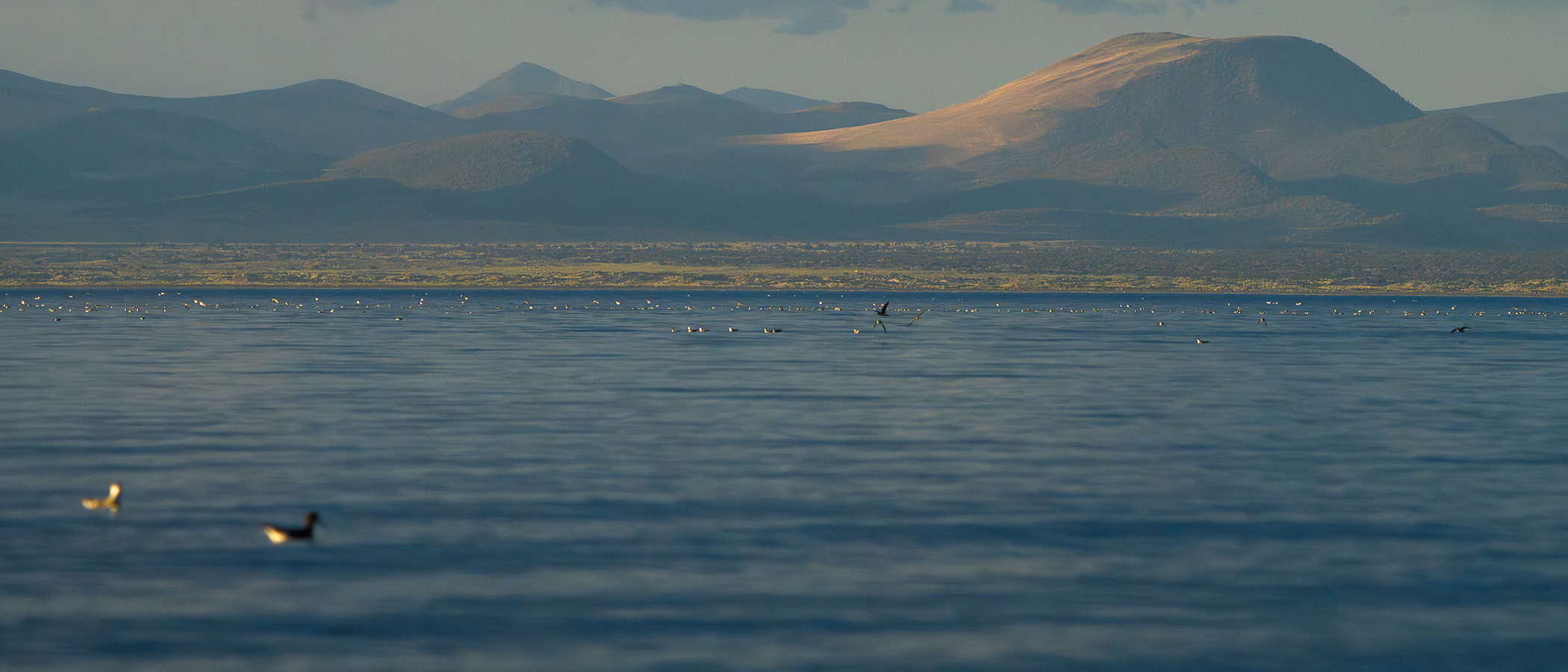
Top photo courtesy of Halie Cook.