The significance of the State Water Board’s March 17 meeting and receipt of a new climate report on Mono Lake is not lost on the news media.
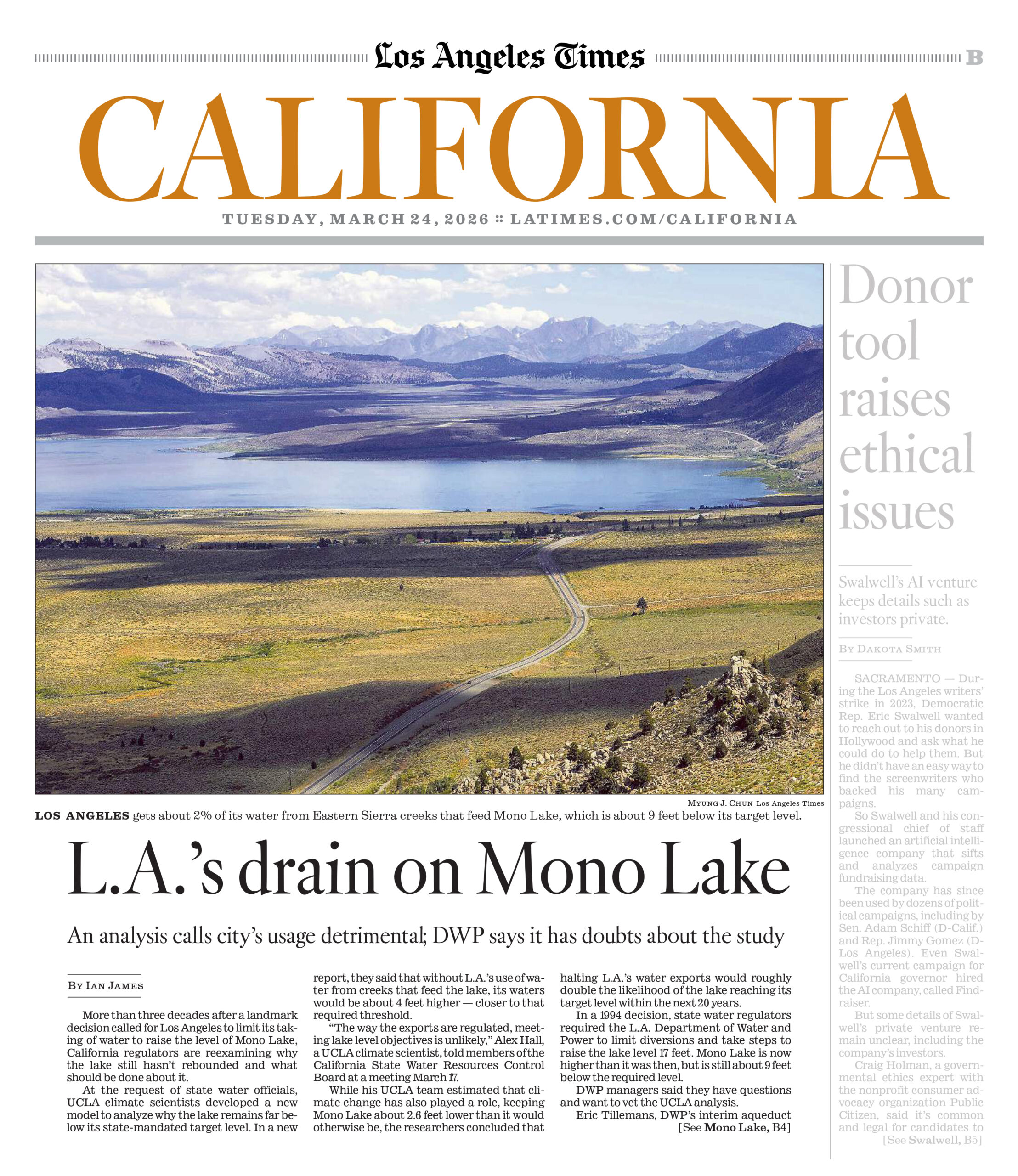
Articles in both the Los Angeles Times and the San Francisco Chronicle highlighted key report takeaways; ongoing Los Angeles Department of Water & Power (DWP) water diversions are the main cause of the present-day low lake level, and current diversion levels are unlikely to allow the lake to rise.
At the request of state water officials, UCLA climate scientists developed a new model to analyze why the lake remains far below its state-mandated target level. In a new report, they said that without L.A.’s use of water from creeks that feed the lake, its waters would be about 4 feet higher — closer to that required threshold.
—LA Times, “L.A.’s drain on Mono Lake” by Ian James, March 19, 2026
“The way the exports are regulated, meeting lake level objectives is unlikely,” Alex Hall, a UCLA climate scientist, told members of the California State Water Resources Control Board at a meeting Tuesday.
While his UCLA team estimated that climate change has also played a role, keeping Mono Lake about 2.6 feet lower than it would otherwise be, the researchers concluded that halting L.A.’s water exports would roughly double the likelihood of the lake reaching its target level within the next 20 years.
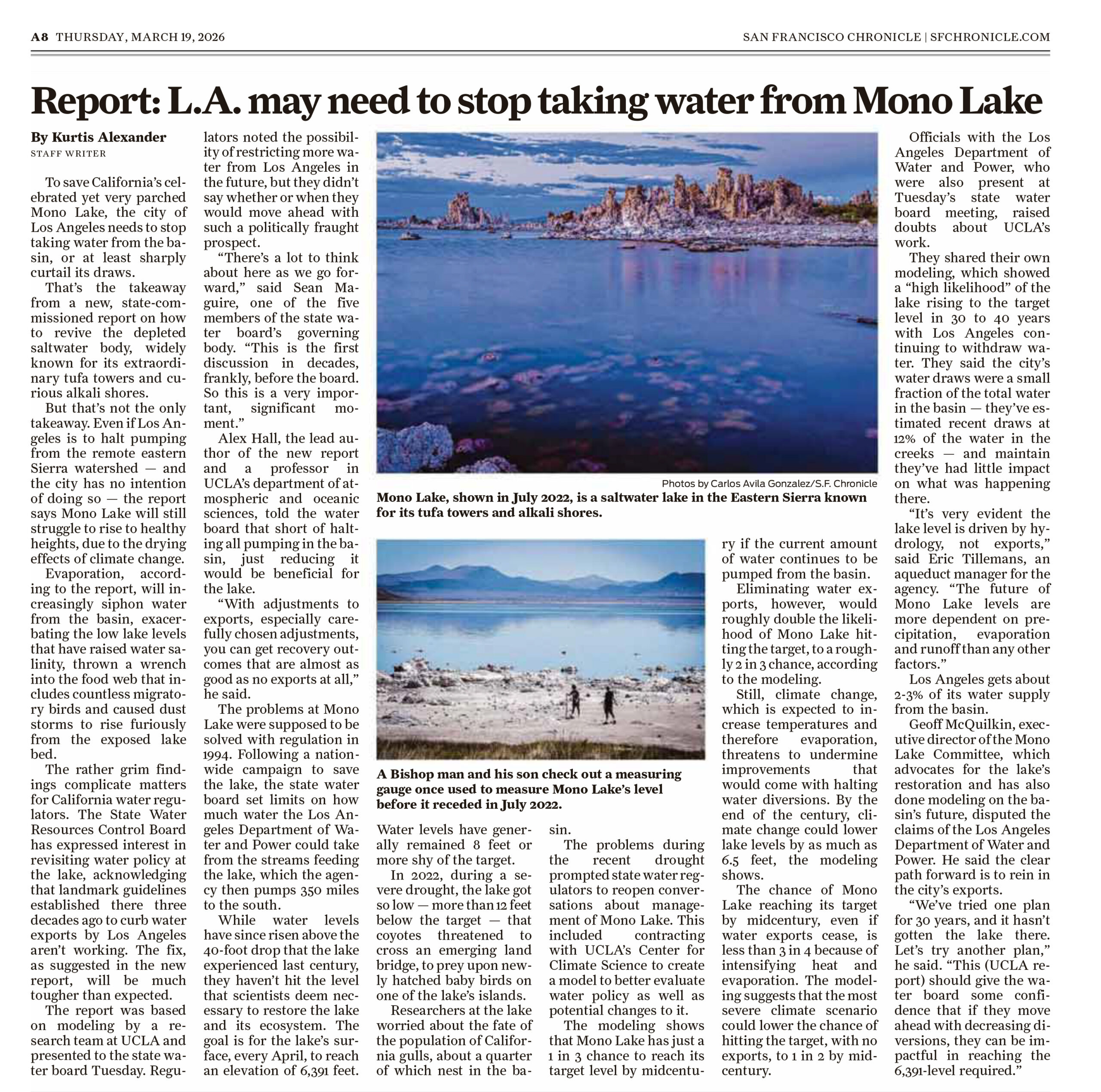
To save California’s celebrated yet very parched Mono Lake, the city of Los Angeles needs to stop taking water from the basin, or at least sharply curtail its draws.
— San Francisco Chronicle “California report offers a controversial way to save Mono Lake” by Kurtis Alexander, March 17, 2026
That’s the takeaway from a new, state-commissioned report on how to revive the depleted saltwater body, widely known for its extraordinary tufa towers and curious alkali shores.
In a five-hour agenda item at its regular meeting in Sacramento, the State Water Board focused on Mono Lake’s low level. A new Mono Lake report and water budget model from the UCLA Center for Climate Science was the impetus, and there was robust discussion followed by extensive public comments. At the conclusion, Board members agreed: a formal, decision-making hearing about DWP water diversions is necessary, this year.
The UCLA team presented a project overview and key findings. The report shows that while climate change is a factor, ongoing DWP water diversions are the main cause of the present-day low lake level. The report also shows that current diversion levels are unlikely to allow the lake to rise. Yet, the report concludes that Mono Lake recovery is still achievable if water diversions are reduced—a clear opportunity for meaningful action by the Board.