Annual lake level measurement
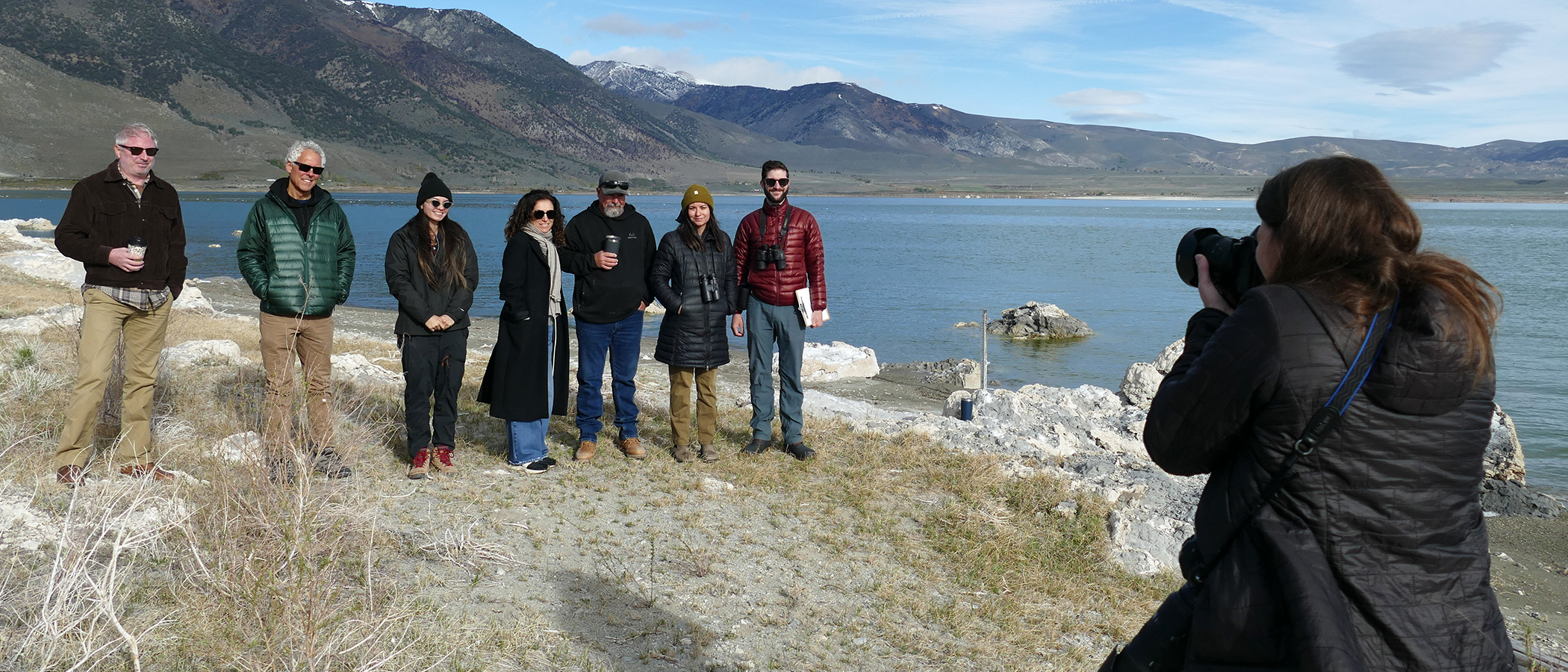
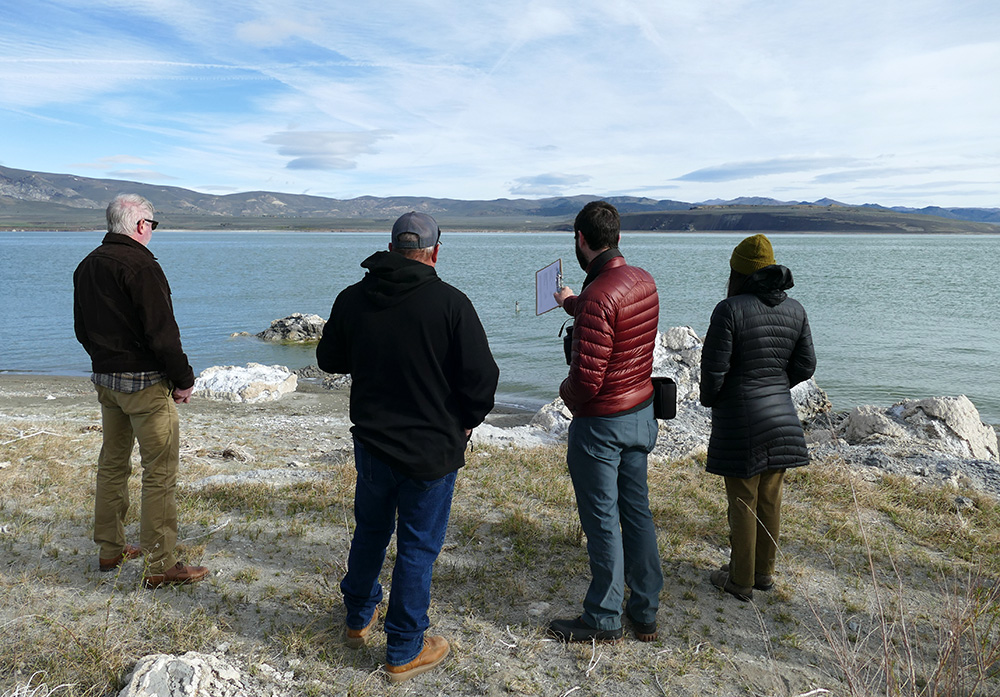
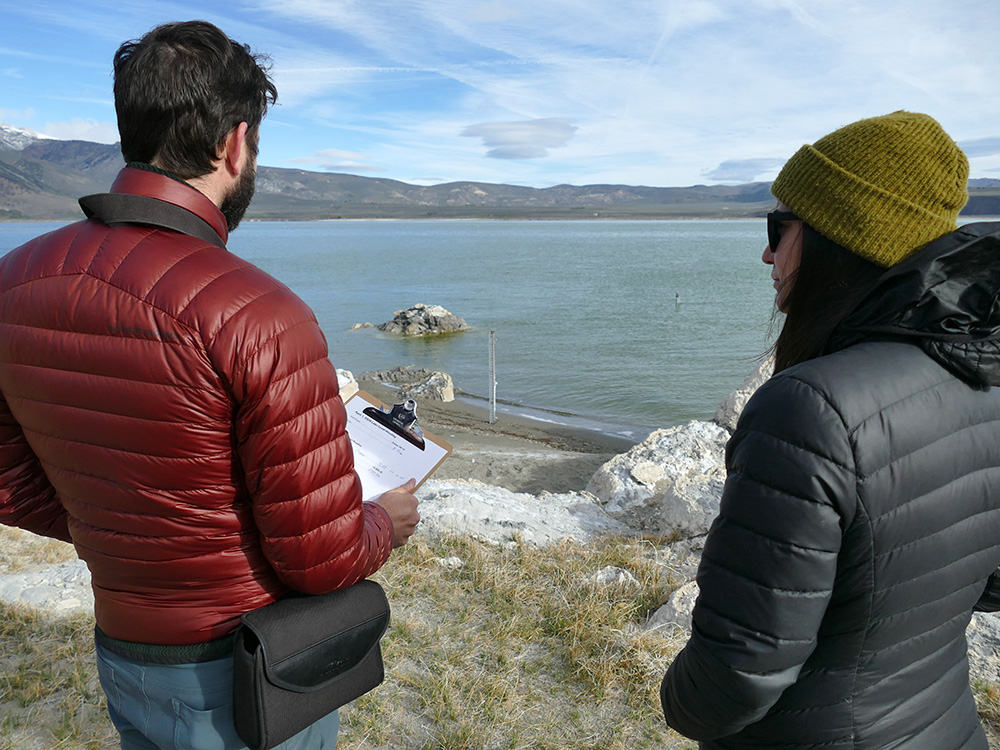
Yesterday staff from the Mono Lake Committee and Los Angeles Department of Water & Power (DWP) met at the shore of Mono Lake to cooperatively read the lake level gauge, as is customary at the start of each new runoff year.
Mono Lake stands at 6,382.75 feet above sea level, which is, for some perspective, 9.25 feet below the healthy management level mandated by the California State Water Resources Control Board more than 30 years ago, in 1994.
That lake level means DWP is allowed, but not required, to divert a maximum of 16,000 acre-feet of water from Mono Lake’s tributary streams this year. DWP has maximized diversions every year since the State Water Board ordered, and DWP agreed, that Mono Lake rise to a sustainable level. Even when pressed to reduce exports, like in 2024 when LA Mayor Karen Bass directed DWP to take less water from the Mono Basin, DWP exports as much as it can (that year, instead of following the mayor’s direction to take only 4,500 acre-feet, DWP diverted 11,000 acre-feet).
Long-term damage to the Mono Basin
DWP’s stream diversions have imperiled Mono Lake for more than 80 years, causing its precipitous drop and near ecological collapse by the 1970s.
Continued diversions are the primary reason why Mono Lake cannot rise to its healthy management level ordered by the State Water Board. A recent report from the UCLA Center for Climate Science, commissioned by the Board, shows that DWP diversions have twice the impact of climate change on Mono Lake’s level.
DWP often touts its commitment to environmental protection in the Mono Basin, but that is lip service as long as DWP continues to shirk its most fundamental responsibility to restore the damage done by its decades of diversions and provide Mono Lake the water it needs to rise to 6,392 feet.
The value of Mono Basin water
Mono Basin water makes up just 1–3% of Los Angeles’ water supply, a small part of a diverse and efficient portfolio of sources, many of which are truly local to LA and therefore more resilient than importing water from distant sources like the Eastern Sierra.
In addition, an expansion underway at the Tillman Water Reclamation Plant will supply LA with more than double the amount of water DWP gets from the Mono Basin when it comes online next year. As former DWP Commission President Richard Katz has described in detail, this will allow DWP to comfortably, and temporarily, pause Mono Basin diversions to let Mono Lake rise to the management level.
In contrast, Mono Basin water provides 100% of Mono Lake’s water supply. There are no other sources of water for this ecosystem to make up the shortfall caused by DWP’s diversions. Mono Basin water may be valuable to DWP, but it is priceless to Mono Lake.
Looking ahead
April 1 resets the annual water export allowance, and this year DWP began exporting water right away on Wednesday, shortly after the joint lake level reading, already chipping away at the small rise Mono Lake will experience this spring.
Fortunately, at its meeting in mid-March, the State Water Board members heard loud and clear the need to revisit the diversion rules and reduce DWP’s exports. All five Board members expressed support for initiating a hearing this year to consider to modifying water diversion maximums.
In the meantime, as has been the case since 1994, DWP is welcome to reduce or pause its exports voluntarily, especially since the recent UCLA report makes it abundantly clear that the impact of DWP’s exports to date is far worse than climate change for Mono Lake. In refusing to help Mono Lake rise, DWP’s actions run counter to leadership and constituent voices in the LA community: The mayor, current and former City Council members, the Los Angeles Business Council, a former DWP Commissioner, leading environmentalists, prominent citizens, ratepayers, and many more are calling for a solution for Mono Lake.
Temporarily pausing diversions could be just that solution.
Top photo by Elin Ljung.