The Los Angeles Department of Water & Power (DWP) has diverted water from the Mono Basin for 85 years, and the impacts to the lake’s ecological health are accumulating.
Diversions from Mono Lake’s tributary streams have dramatically reduced the lake’s elevation and volume, increased salinity, and created conditions that are disrupting ecosystem function and the food that supports nesting and migratory birds. In particular, these conditions are reducing the survival of California Gull chicks.
If this sounds like a repeat of a story from the early days of the effort to save Mono Lake, it is. But with the passage of time it has become worse, as the number of nesting gulls at Mono Lake has plummeted by two-thirds, and the productivity of the lake’s ecological engine—phytoplankton and brine shrimp—is showing signs of stress and systemic dysfunction.
Declining numbers of gulls
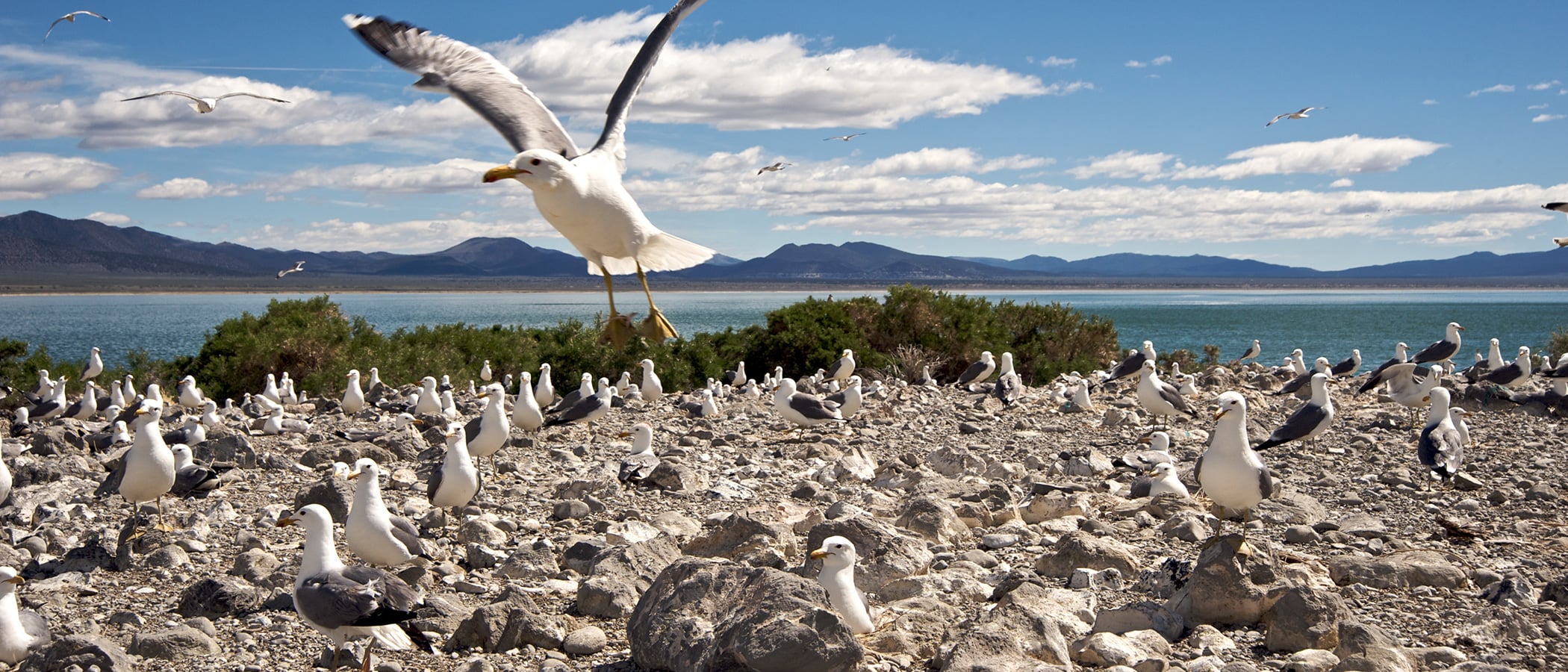
Mono Lake’s most iconic nesting bird species, the California Gull, is suffering an alarming decline. In 2024, California Gulls endured a near-complete nest failure at Mono Lake: Only an estimated 324 chicks fledged from an estimated 11,000 nests. According to Ryan Burnett, the lead California Gull researcher from Point Blue Conservation Science, “This total chick production is by far the lowest we have ever documented at Mono Lake.” Fortunately, in 2025, the gulls avoided a similar catastrophe with an estimated 5,494 chicks fledging from 10,565 nests. While last year’s rebound was a relief for the survival of gulls, it is well below the long-term average for reproductive success at the lake and it is part of a long-term, downward trend.
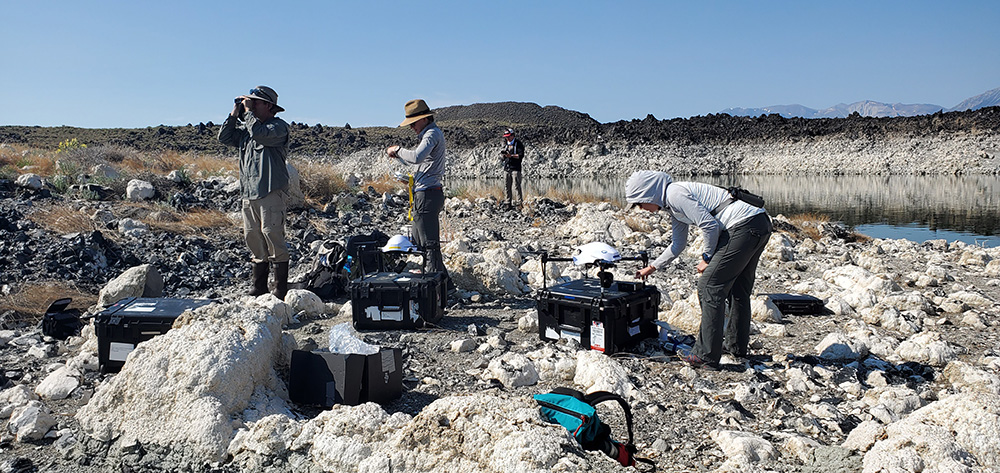
The number of nests counted in 2025 was the second lowest in the 43-year history of the study, and according to Point Blue, “The 2025 breeding population represented a 67% reduction from the largest breeding population we have documented during our study of 32,488 nests in 1992.” Gulls have suffered a range of impacts due to a low lake level, including coyote predation, swings in brine shrimp emergence and availability, and invasive weeds encroaching on their nesting habitat. The sum of these impacts can be traced to a legacy of continuing DWP diversions. Diversions have kept Mono Lake too low for too long, and the steep decline in the gulls’ population indicates that neither Mono Lake nor its biodiversity are protected.
Chronically low lake level causes stratification and ecosystem stress
The physics and chemistry of an artificially low Mono Lake work against the timing and abundance of brine shrimp emergence, a critical source of food for nesting gulls as well as many other birds. The current low lake level and corresponding high salinity make the lake vulnerable to stratification after big precipitation and runoff years.
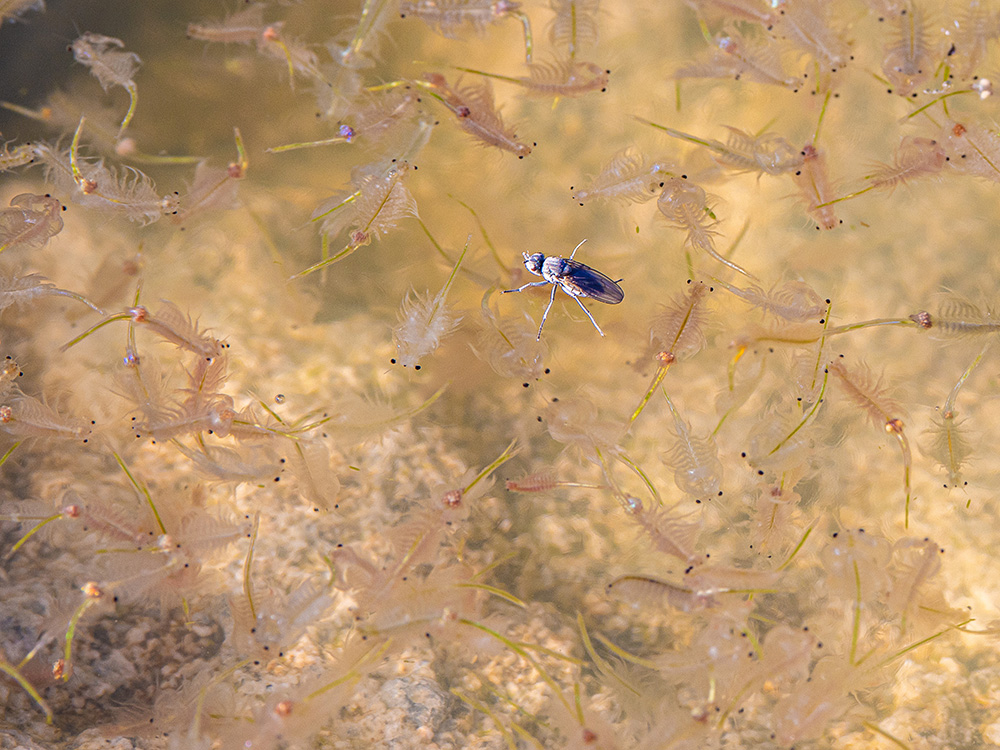
The lake’s ecosystem responds positively to the water column mixing, or “turning over,” each year, cycling nutrients upward from the bottom of the lake. However, when the lake is artificially low during a high runoff year, the big pulse of incoming freshwater mixes partially with the lake surface, but not with the deeper, more saline water below. The larger volume of less dense, less saline water caps the lake surface and impedes the lake’s cycle of mixing. Nutrients get trapped in the deepest parts of the lake, initiating a cascade of detrimental ecosystem changes the following spring. Fewer nutrients in the water column limit phytoplankton growth, which limits brine shrimp abundance and changes hatch and growth timing. This, in turn, reduces the abundance and changes the timing of food for birds. According to the 2024 Mono Lake Limnological Monitoring Annual Report, “Six episodes of persistent stratification (meromixis) have occurred since 1982.” The report also says, “The recurring multi-year episodes of meromixis have introduced large variations in mixing and nutrient supply which complicate analysis of the effects of changing salinity associated with lake level management.” In other words, lake stratification is a disruptive, repetitive event—now unfortunately common—due to low lake volumes caused by nearly a century of DWP’s water diversions.
New signs of instability
What are the long-term impacts of repeated stratification events or persistently high salinities? While there are no simple answers, troubling signs of ecosystem disequilibrium are emerging. These include persistent and mysterious episodes of atypical algal abundance throughout the water column and a decline in brine shrimp size and egg productivity. According to the 2024 report, “…the long-term trend of decreasing female [brine shrimp] length and fecundity continues,” and, “The annual production of over-winter [eggs] was the lowest observed since calculations began in 1983.” More focused study might help to precisely unravel the complexities of these disturbing trends, but the trends have all occurred within the context of a lake that remains nine feet below what is required with no sustained progress toward higher elevations and reduced salinities.
There is a solution
How do you remedy the ecosystem stress at Mono Lake? Raise the lake to the mandated 6,392-foot level. Pausing diversions will increase the lake level and total lake volume, better protect nesting California Gulls, reduce salinity, improve ecosystem productivity, and make the lake resistant to multi-year stratifications that limit nutrient mixing.
An update to the diversion criteria to achieve a healthy, protected lake is long overdue. The current diversion criteria, now 32 years old, that allow DWP to divert water away from the lake, are not only failing to achieve a higher lake level, but are causing harm to the lake’s ecological health by blocking the most rapid path toward recovery.
This post was also published as an article in the Summer 2026 Mono Lake Newsletter. Top photo by Russ Taylor.
Enough is enough. Years after the mandated return to a safe level, LADWP continues to kill the lake, the ecosystem and the humans who live nearby. None of this destruction can be undone, it can only be halted. Look at what is being sacrificed on the altar of civility and timidity. While I can appreciate the respectful stance the Committee has long taken, it’s time to take the gloves off. I pledge to double my monthly contribution once we engage in litigation.
sincerely,
Dan Matarozzi
San Francisco