A report from UCLA released this spring, commissioned by the California State Water Resources Control Board, states that water diversions by the Los Angeles Department of Water & Power (DWP) are the primary reason that Mono Lake is not at a higher elevation today. The report advises that reducing these diversions will give Mono Lake the best chance to rise to the mandated Public Trust lake level, even in the era of climate change.
UCLA Mono Lake Model
Project summary: Mono Lake in a Changing Climate
Main report: Development of a Mono Lake Water Level Model and Projections Across the 21st Century
Report Appendix
Concern over Mono Lake’s slow recovery led to the report. In February 2023, the State Water Board held a workshop to consider the problem of Mono Lake’s chronically low level. In response to this discussion, Board staff contracted the UCLA Center for Climate Science to develop a hydrological model for the Mono Basin that incorporates current understanding of climate change in California. The scientists who developed the report are leaders in global and California climate modeling.
Model development and reporting spanned three years, and the UCLA scientists consulted experts at the Mono Lake Committee and DWP throughout the development process. In March 2026, the State Water Board released the UCLA Mono Lake Model final report. Two hundred pages of technical description can be boiled down to these takeaways:
1. Ongoing DWP water diversions are the major cause of the present-day low lake level.
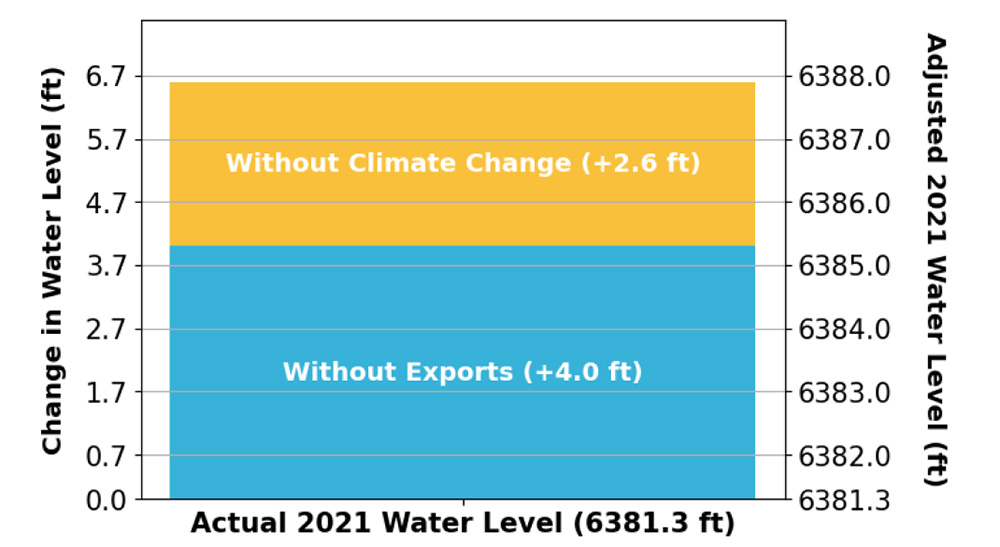
Why has Mono Lake been slow to recover since the 1994 decision to protect it? The UCLA model analysis contrasted the impact of the last 30 years of climate change with the nearly 400,000 acre-feet of streamwater diversions exported from the Mono Basin during this period. Results indicate that since 1994 diversions have had a 50% greater impact on the state of the lake than changes in climate (see figure above). This finding disputes DWP’s assertion that exports have a negligible impact on Mono Lake.
2. Current diversion criteria are unlikely to allow the lake to rise to the 6,392-foot Public Trust lake level.
The UCLA model utilized 33 future climate projections to model Mono Lake rise over the coming decades. Under the current diversion rules, less than 40% of model runs reach 6,392 feet within 40 years. This result tracks with the observed lake level fluctuations over the past 30 years; lake level rise has stalled below 6,385 feet under the current diversion rules, with no net rise since 1999.
3. Mono Lake recovery is still achievable, even with climate change, if diversions are reduced.
The percentage of successful model runs doubles when diversions are paused. Under every climate projection, the effect of diversions is evident, with increasing impacts over time. While pausing diversions is the most effective way to raise the lake, the UCLA model report also outlines alternative diversion criteria that raise the lake while allowing some water export to LA, especially during critically dry years when LA’s water supply is limited.
The UCLA model adds knowledge to the current ensemble of models used to evaluate Mono Lake’s elevation. Importantly, the new model’s results align with the conclusions of the existing models. Hydrology or climate models cannot predict future Mono Lake levels; however, when there is agreement between independently developed models, the conclusions are strengthened. In particular, the current Mono Lake models—and recent experience—agree that DWP diversions limit Mono Lake’s rise and must be adjusted to protect Public Trust values. The UCLA model is the first Mono Lake model to incorporate future climate change and the report gives us confidence that saving Mono Lake remains in reach.
UCLA Mono Lake Model
The State Water Board contracted the UCLA Center for Climate Science to develop a water budget model to better understand how climate change and surface water diversions had and will continue to impact Mono Lake.
Project summary: Mono Lake in a Changing Climate
Main report: Development of a Mono Lake Water Level Model and Projections Across the 21st Century
Report Appendix
UCLA project leaders Dr. Alex Hall and Dr. Benjamin Bass presented this report at the March 17, 2026 State Water Board meeting. Video of that presentation, plus the entire Mono Lake agenda item, can be found here.
This post was also published as an article in the Summer 2026 Mono Lake Newsletter. Top photo by Elin Ljung.